Index
Home
About
Blog
From: John De Armond
Newsgroups: rec.outdoors.rv-travel
Subject: Re: IR Thermometer
Date: Tue, 09 Mar 2004 00:53:40 -0500
Message-ID: <vemq405ib7qoqnvbuq835ve3i5mhu9rknm@4ax.com>

The pyrometer sensor generates an output proportional to the difference in its
substrate (background, reference junction) temperature and the temperature on
the microthermopiles inside.  The sensor is therefore temperature compensated
by means of some sort of sensor, usually a diode, mounted near or in contact
with the pyrometer sensor.  It takes awhile for the change in ambient
temperature to filter through to the diode sensor while the thermopiles sence
the change in radiation immediately.  Only when the two are again equal will
the compensation be correct.

Fancy ones like my Wahl have a "zero" function in which one half-pulls the
trigger which raises a black target in front of the pyrometer sensor.  The
processor logs that as "zero".  A complete pull on the trigger moves the flag
past the sensor and opens the optical path from the infrared telescope,
enabling a reading.

Even on the fancy one, a zero'ing is necessary every few minutes after a big
ambient temperature change, until the instrument temperature equilibrates with
the new ambient.

On Mon, 08 Mar 2004 23:22:21 -0500, bill horne <redydog@rye.net> wrote:

>Peter Pan wrote:
>
>> How far away from the bulbs are you? To be PC we should probably standardize
>> on distance. I'm playing with mine on the lights here, and the closer I get,
>> the more the temp goes up.
>
>About 2-3 inches.
>
>And I ran into the abrupt temperature change problem last night. I went
>out to try to repeat the previous nights results, and I got
>not-believable results from van body, tires, and woods - off by 20-30
>degrees. So I left it outside for about 30 minutes, and tried again -
>back within 2-3 degrees of another thermometer.
>
>The manual apparently means what it says - that the device itself must
>be cooled or warmed to near-ambient temp before it'll read correctly.
>And no, I don't know what "near" means yet - but I know that going from
>a 75 deg house to a 40 deg yard is way too much for it to handle.
>
>A quick web crawl indicates that this true of even more expensive ones -
>until they get expensive enough to have some form of ambient temp
>compensation.
>
From: John De Armond
Newsgroups: rec.outdoors.rv-travel
Subject: Re: IR Thermometer
Date: Tue, 09 Mar 2004 12:52:01 -0500
Message-ID: <010s40d3o3tr3o6gv6k4eh5v9me3aushng@4ax.com>

There ya go, Bill, twisting my arm and making me take one apart...  Actually
I'd been looking for an excuse. :-)  Since a picture is worth a thousand
words:
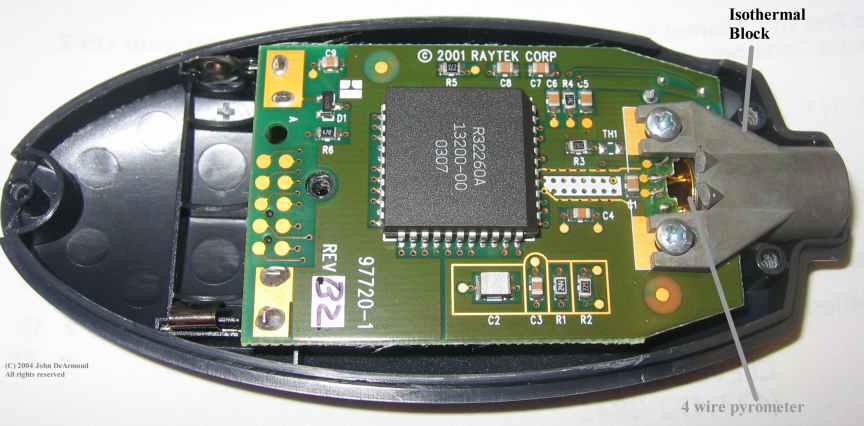
A shot of the internals.  First thing I notice is the Raytek logo.  This is
super very good stuff!  Raytek and Wahl are the Big Two in the IR thermometry
field.  No wonder the thing works so well.  To the right is the pyrometer
attached to an isothermal mass.  This mass does two things: It slows the
change in temperature the pyrometer sees and it provides the pyrometer a nice
even thermal background.  Note that the pyrometer is a 4 lead device.  More on
that later.
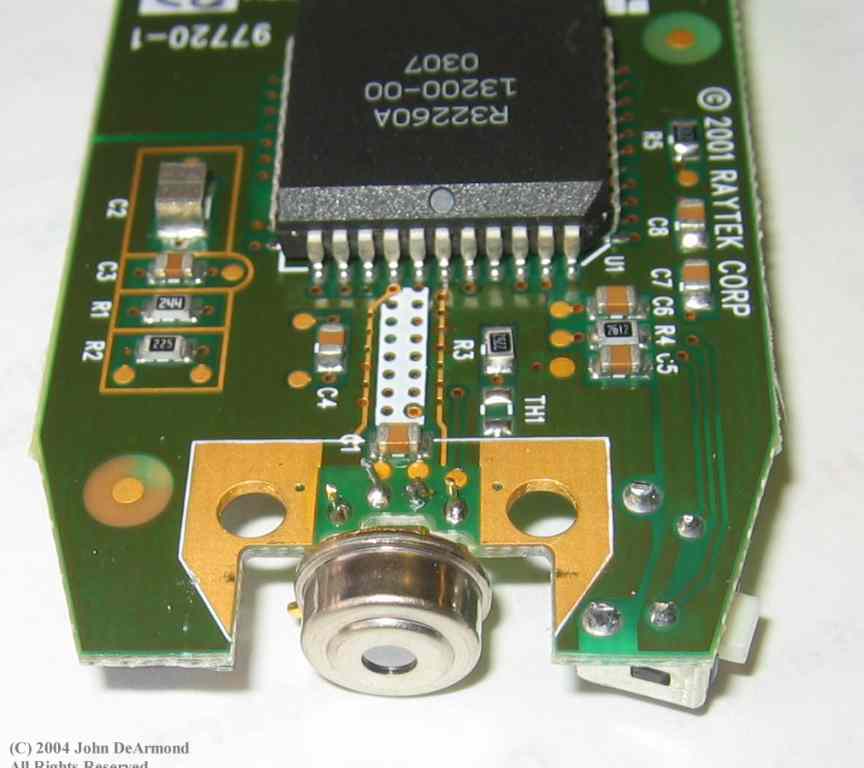
Here is the pyrometer removed from the isothermal block.  Looks like a zinc
selenide unit.  I paid several hundred $$$ for a bare sensor perhaps 5 years
ago.  Yeah for Moore's Law!!
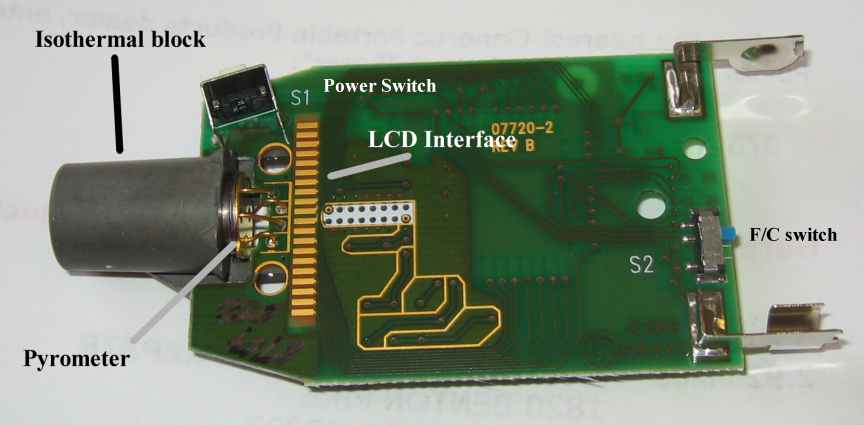
Back side of the PCB showing several switches and connectors.  The LCD
interface is to note.  IT connects to the LCD display via a conductive rubber
strip.  If your thermometer starts dropping segments or gets dim, take the
unit apart, clean these contacts with PGA, dry and reassemble.  Do not touch
the conductive rubber unless absolutely necessary.  I've never had much luck
getting the thing to conduct after molesting one.
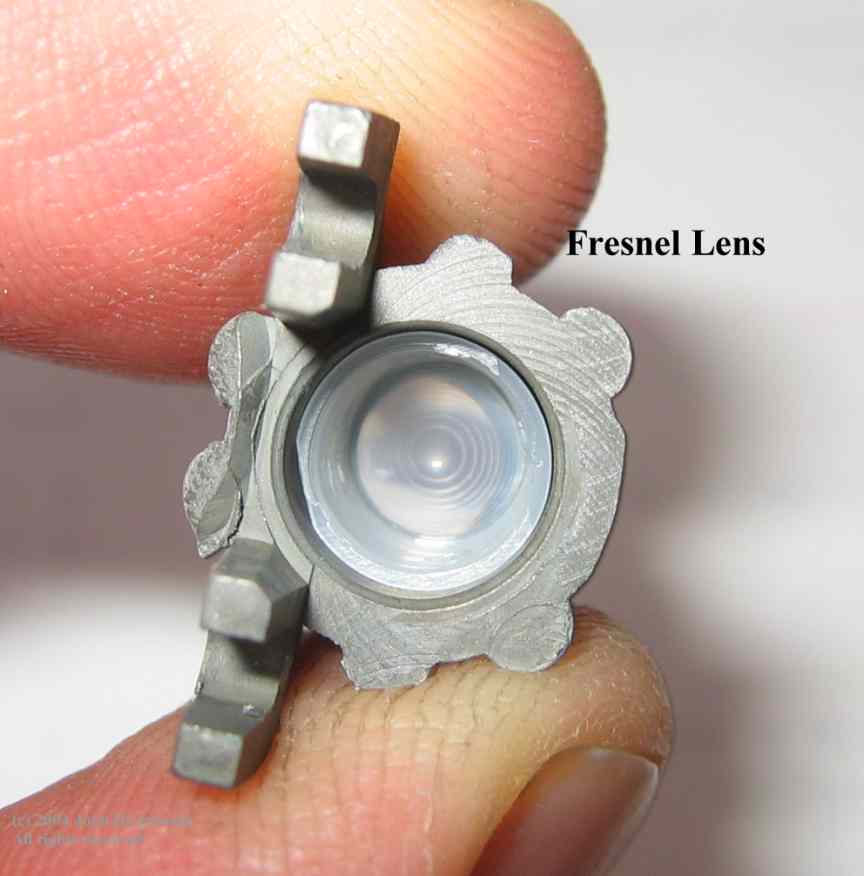
This is one of the most important feature and what sets this unit apart from
the other cheap ones.  An infrared Fresnel lens that focuses the field onto
the pyrometer.  Most of the cheap units I've seen have no lens and simply
expose the pyrometer sensor to the world.  With no focus, the sensor responds
to everything in the field of view.  This lens narrows the field of view and
screens off-axis IR radiation.

Now to your question, Bill.  The 4 leads emitting from the pyrometer device
indicates one of two things to me.  I'm not sure which, as I haven't kept up
with this field in a couple of years.  One possibility is that the temperature
compensation sensor is built in the pyrometer package.  The other possibility
is that the sensor can be electronically "blinded" so that it can read its own
temperature.

In either event, the actual pyrometer package is where the reference
temperature is measured.  The package is contained within that isothermal
metal block.  Ergo, the whole block must reach the new ambient before the unit
will indicate accurately again.

Swinging the unit hole forward would indeed help, as the isothermal block
extends to the face of the unit.  Drilling some small vent holes in the case
near the sensor would also help, at the loss of some amount of water
resistance.

Seeing how well this thing is designed I think I'm going to go snarf up the
remaining stock at my local Rat Shack :-)

John


On Tue, 09 Mar 2004 01:38:57 -0500, bill horne <redydog@rye.net> wrote:

>Neon John wrote:
>>
>> The pyrometer sensor generates an output proportional to the difference in its
>> substrate (background, reference junction) temperature and the temperature on
>> the microthermopiles inside.  The sensor is therefore temperature compensated
>> by means of some sort of sensor, usually a diode, mounted near or in contact
>> with the pyrometer sensor.  It takes awhile for the change in ambient
>> temperature to filter through to the diode sensor while the thermopiles sence
>> the change in radiation immediately.  Only when the two are again equal will
>> the compensation be correct.
>>
>> ---
>> John De Armond
>
>Does that mean that swinging the thing eyehole forward through the air
>might make it ready sooner?
From: John De Armond
Newsgroups: rec.outdoors.rv-travel
Subject: Re: IR Thermometer
Date: Wed, 10 Mar 2004 01:03:17 -0500
Message-ID: <uiat40p6treb5gfbmbacoaa0c5fgv3hf5g@4ax.com>

I can't imagine any universal formula.  Assuming the instrument had
equilibrated to the van's temperature, at the instant you step outside, you
should be able to just add or subtract (depending on which way the temperature
is inside vs out) the difference between inside and out.  If this works it
would only work for a few seconds, as the pyrometer chip immediately starts
cooling or heating as the case may be via IR radiation.

This problem exists even on my fancy unit.  If I aim it at something fairly
hot, the IR radiation will heat up the sensor more rapidly than the
compensation can work.  With an open shutter, this constitutes itself as long
term (minutes) drift.  Similarly, if I take it outside into the cold, the
sensor cools by radiation faster than the heat can be pulled from the
compensation sensor.  It drifts down.  The only solution I've found is to
half-trigger and zero immediately before each reading.  This thing has a
1mv/deg analog output but the drift renders it useless for long term data
logging.  My unit is >10 years old so maybe they've improved things in later
models.

For a really fancy one, check this one out:
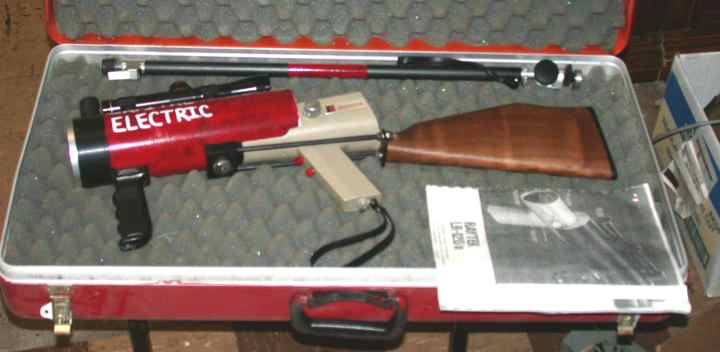
This is a hand-held reflector telescope with a pyrometer sensor mounted in the
focus.  Also a Raytek product.  The rifle scope aims coaxially with the
telescope via a periscope arrangement.  No parallax error.  As long as the
target can fill the little square in the cross-hairs, the instrument can read
the temperature, regardless of the distance.  One can measure an individual
wire clamp on an overhead transmission line, even on the next block!  This
instrument addresses the problem you're having the old fashioned way - it
reads in degrees above ambient and has a little mercury thermometer to show
ambient temperature.  One does the math in his head :-)

BTW, you ought to see the looks I get as I walk along a street looking at the
overhead lines while holding the raygun out and up like a rifle...

John

On Tue, 09 Mar 2004 16:19:45 -0500, bill horne <redydog@rye.net> wrote:

>Thanks, John. I knew you'd come through. And before you lose your
>momentum, here's one more:
>
>Is there a table, chart, graph, formula or something for this thing, so
>that I could adjust it on the fly by adding or subtracting a number
>based on the difference between ambient and phaser temp?
>
>For example, say that I know the the temp of the phaser because it's
>been riding in the van with me, and I know the temp in the van. I either
>know - or can measure with a regular thermometer - the outside temp. So
>I'm busting down the road and decide to stop and check my tires - and I
>don't want to wait 30 minutes. it's 75 in the van, and 35 outside. I
>stop, jump out, zap a tire, and get a not-believable reading. Then I
>apply the magic fudge factor to the reading, and get a much more
>accurate reading. Possible? Oh. Sorry. That makes it two more questions.
>
>Kind of ironic that this thing can measure a temp in half a second, but
>you might have to wait 30 minutes for it to get its ducks lined up if
>you don't plan ahead.
Index
Home
About
Blog