Index
Home
About
Blog
From: John De Armond
Newsgroups: alt.energy.homepower
Subject: Re: Generator advice
Date: Tue, 20 Feb 2007 00:38:37 -0500
Message-ID: <jd1lt29sapehqoh5qc92biikmt8bqk7p1i@4ax.com>

On Mon, 19 Feb 2007 19:08:10 -0500, "(PeteCresswell)" <x@y.Invalid>
wrote:

>Per _jj_:
>>Thanks for the web link... but  .. Yikes  -  what a price !
>>... and a person would still need to buy the generator breaker;
>>receptacle; inspection;  ...
>> Seems very costly.
>
>Seems like nobody's talking about the #10-gauge extension cord alternative.

Cuz after you try it once you won't try it again.

Winter storm hits.  Drag out the generator and the 200 lbs of
extension cords.  I want to run my fridges, my freezers, my lights,
the blower in the fireplace and the heatpump (at least the fan to
distribute the fireplace stove heat around the house.  In the
mountains the power can be off for 2 hours or 2 weeks so one doesn't
go on a wish and a prayer that the fridges will ride it through.  They
have to be powered.

So I run this big-assed cord in through a cracked door.  Fan it out
with splitters to all the loads. With the 'fridges and freezers, I
have to wrestle them out from the wall to get at the power cords. Hope
that wasn't my back going out again.

The heat pump is 240 volts so I have to run a separate cord for that.
Then I have to open the breaker panel, lift the heat pump wires and
wirenut the extension cord onto them.  Lash all this crap together,
start the generator and sit down with a smug look.....

Five minutes later I realize that my feet are freezing.  That big
honking cord is holding the door open a crack, enough to let cold air
in.  Stuff some blankets in the crack.  No, that didn't work so well,
especially after the first wind gust.  So disconnect the cord, remove
a screen from a window, toss the cord out the window and hook it back
up.  Find some duct tape and tape up the window opening.

Stroll into the kitchen to get some hot coffee to warm up again
and..... Trip over the friggin' cord in the middle of the floor.  So
now I kick the cords over to the side and spend an hour or so taping
them all down.

Just about the time I get through with that the power comes back on.
Now I gotta traipse around collecting up cords, using very tired arms
to coil them back up, haul them back to the basement, lug the
generator back in and then on top of everything else, wire the heat
pump back up so I can have some heat in the bathroom for the hour long
shower it takes to recover.  Of course the whole day is shot.

Contrast that to:

Roll the genny out and crank it.  Open the breaker panel, trip the
main breaker, close the generator backfeed breaker, toss the Jesus
cord out to the generator, plug it in, flip the generator breaker on
and go back inside where everything is working just fine.

Or if you want to spend the extra money, substitute "throw the
transfer switch" for tripping the main breaker and closing the
generator backfeed breaker.

I did the extension cord thing once. Never again.  I was lucky in that
I had all the cords on hand from my portable food service business.
I'd have been REALLY pissed had I spent a few hundred bux on 10ga
cords and associated hardware.

John
From: John De Armond
Newsgroups: alt.energy.homepower
Subject: Re: Generator advice
Date: Tue, 20 Feb 2007 19:54:19 -0500
Message-ID: <m95nt2tqj2kb4uoq4a8qqq0gu9s7nnfei4@4ax.com>

On 20 Feb 2007 06:13:40 -0800, "hebintn" <bryant539117@bellsouth.net>
wrote:


>It sounds like the "cheap" way out would work for me as long my old
>brain remembers not to turn on the main breaker- perhaps a piece of
>tape would be sufficient.

I set my cabin up so that my then-83 year old dad could do it
correctly and reliably.

I painted each breaker and connector a different color and placed a
large number next to each.  Then I typed up a numbered procedure, set
it in 36 point type and colored each step to match the paint.  Copies
of this were attached to the breaker panel, the generator and the
Jesus cord junction box.  I walked him through it a couple times and
then had him do it on his own.  No problems.

In my case, the breaker panel is in the mud room while the genny and
Jesus cord connection are in the basement.  I ran suitably sized wire
from the breaker panel to a Handy-type junction box attached to the
basement wall.  From the Handy box is 35 ft of 8/4 type SO (rubber
covered industrial extension cord cable) cable that ends in a male
twist-lock connector that mates to the generator.

There is a second Handy Box next to the one that serves as a junction
box.  Mounted on it is a female twist-lock connector identical to the
one on the generator.  Connected to this connector are a pair of pilot
lights.  The male end (Jesus end, so named because if misused it can
help you meet Him a little sooner than planned :-) of the cord is
stored in this outlet when not in use.  The pilot lights indicate that
the male prongs of the connector are hot and would be hazardous if
removed from the storage connector.  If the pilot lights are on then
something has been done wrong and he needs to start over.

This has worked perfectly for years.  Dad's dead now but I keep the
procedure in place just in case someone I might lend my cabin to has
to execute it.

For various reasons, installing a transfer switch would be a huge,
major and expensive pain-in-the-*ss so this hookup and procedure are
the next best things.

John
From: John De Armond
Newsgroups: misc.rural
Subject: Re: Preparing for Power Outages?
Date: Wed, 28 Feb 2007 11:23:43 -0500
Message-ID: <1aabu214on4ng25g459qe56310nf4naf44@4ax.com>

On Wed, 28 Feb 2007 10:22:08 -0500, "Don" <one-if-by-land@concord.com>
wrote:


>This one is at the low end:
>http://www.reliancecontrols.com/ProductDetail.aspx?TF151W
>
>And this one is better:
>http://www.reliancecontrols.com/ProductDetail.aspx?20216A
>
>They have an online installation video (which I downloaded) that shows the
>whole process and it looks pretty easy.

Those are both pretty low quality and expensive for what you get.  The
thermal breakers (the round things across the top) are good for only a
few pops and then they're done for.

Here's my low-end approach.

Go to Lowe's or other big box store and get an 8 to 12 slot sub-panel.
This is like a regular breaker panel except that it has no main
breaker.  Populate it with whatever breakers you need.

Install the sub-panel near the main panel and move your vital loads
over to it.  Feed the sub-panel with a 100 amp breaker from the main
panel.

Between the panel and sub-panel, install a Cutler Hammer transfer
switch such as this:

http://www.harborfreight.com/cpi/ctaf/displayitem.taf?Itemnumber=42163

And run your generator cord and plug from the transfer switch.

That seems high but here's the way to cheap out.  There's a surplus
store in Etowah, TN that gets all of Harbor Freight's returns.  Covers
more than a city block.  They're part of this outfit:

Salvage & Surplus Bargain Barn
508 Tennessee Ave
Etowah, TN 37331
(423) 263-1406

Bargain Barn is NOT this outfit - BB sells surplus groceries but they
can give you the phone number.

This place sells the 200 amp switch for $50 and the 100 amp version
for $40.  I picked up a couple the last time I was in.  there were
piles of 'em.

Using this scheme, when the transfer switch is thrown the vital loads
are separated off from the rest and receive generator power.

An even cheaper approach is to simply cut into the main feed between
the meter and the main breaker panel and install the 200 amp version.
The slight disadvantage is that you will have to go through the box
and determine which breakers feed vital loads.  During an outage you'd
have to flip off all the rest.

Personally, if I'm going to all the trouble to install a transfer
switch, I'm going to go the extra little bit and install the
sub-panel.  Keeps things simple during the outage.

Another advantage of the sub-panel approach is that it doesn't require
the meter to be pulled and therefore doesn't require a contractor to
pull the permit (where applicable).  If you're handy with tools, this
is something you can do yourself in a few hours.

John
From: John De Armond
Newsgroups: alt.energy.homepower
Subject: Re: Generator advice
Date: Wed, 28 Feb 2007 08:56:02 -0500
Message-ID: <4nsau2ph2g83emscpmbaea2i4uovf264rk@4ax.com>

On Sun, 25 Feb 2007 15:44:31 GMT, Thomas Horne
<hornetd@mindspring.com> wrote:

>> a) Why is what I do to my own house such a burdensom worry to you?
>>
>
>Because perfectly ordinary working people just like me will be out on
>those lines trying to repair the damage that cut off the power and it
>only takes one mistake for you to kill one of them.  I know that you
>believe that you will never make that mistake.  I doubt if any of the
>back feeders who have killed linemen thought that they would make that
>mistake either.

Since I KNOW that I won't make that kind of mistake we'll discuss the
rest of this as a hypothetical.

>
>I realize that ordinary fallible working folk like myself are unworthy
>of your consideration but fifteen hours into a double shift trying to
>get peoples lights back on we; who unlike you are not perfect; sometimes
>get the grounding connection on the wrong side of the break so that the
>conductor we are about to apply a splice to is double grounded on one
>side of the break and ungrounded on the other.  We are after all only
>human, unlike yourself.

Ah, the heroic lineman slaving away against all odds, natural and
manmade, to save humanity.  Spare me.  You're not talking to a lowly
"civilian".  I'm someone who's been right there on the hooks and in
the bucket just like you (if you're not a complete poseur.)

Let's examine your statement a bit.  Of the following things, which do
you suppose presents the most threat:

1 A live line falling on you while you work.
2 The wrong breaker back at the sub being opened for the job
3 Someone, say, a supervisor, violating the tag-out order and closing
in a breaker on a line under repair.
4 The wrong breaker being closed, hotting up the line under repair.
5 Induction from adjacent lines making the "dead" line hot.
6 Static, lightning, switching surges, etc, making the "dead" line
hot.
(any number of other incidents)
100,000 Someone backfeeding from a generator making the "dead" line
hot.

Hint: I put them in approximately the order that I perceive the risk
to be.  I've personally experienced items 1-3.  Only result in each
case was the grounding line jumping from the fault current and
(sometimes) a flash off in the distance.

If you have any training at all (and didn't just show up one day to
start twisting wires together) then you know that ALL conductors are
considered hot and that you wear your hot gloves and your jacket and
insulating hardhat all the time.  And that you gut and blanket any
nearby conductors - dead or alive.  And that you lay grounds BEFORE
you do anything else to work on a "dead" line.

Now, consider your heroic double shift in six feet of snow with 10
inches of ice on everything.....  Do you let your fatigue cause you to
forget your gloves?  How about checking your belt and hooks?  You
know, that ground check you were trained to do.  Do you still remember
to handle conductors with sticks whenever possible?  If you miss any
of these then you don't need to be on a line crew.

>
>The International Brotherhood of Electrical Workers (IBEW) is committed
>to doing everything in it's power to bring charges of manslaughter
>against anyone who causes the death of a wireman or other utility worker
>by generator back feed.  I honestly hope you never have to face such
>charges not because you wouldn't deserve them but because it would mean
>another wireman who is working for all the same reasons that anyone
>works would have died to bring you to account.

With bugles and trumpets playing in the background....  So tell me,
how many cases of backfeed have you ever seen.  I bet none.  I sure
haven't.  One reason I took a couple of days to respond to this
garbage is that I wanted a fact or two.  I called the line supervisor
at one of my client utilities and asked him if he'd ever seen a
backfeed incident.  No.  Did they have one on record.  Took him a day
to look.  No.  This utility serves a  highly rural area where folks
are highly educated and who do what they have to.  If any backfeed
incidents were to happen, I'd expect them here.


>
>I will however admit that I would take inordinate joy from finding out
>that you had destroyed your generator by your own error or even that you
>started a fire in your house with your arrogant methods; as long as
>everyone got out unharmed; because I know that insurance companies will
>not knowingly pay for the consequences of an illegal act.  I wouldn't
>wish you any physical harm because unlike yourself I wouldn't willingly
>take even the smallest chance of burning someone alive.

What you "know" about insurance companies is wrong, of course but
since that's not germane, I'll ignore it.

Let's examine that last statement of your for a moment.  So you
wouldn't take even the smallest change of harming someone?  Let's see
how far you go.  Do you personally lay grounds?  Inspect your fellow
workers' hot gloves?  electrically test them before each use?  Check
the leakage current of the crane and bucket before each job?
Personally go back to the sub to verify the tag out?  Check the
continuity of the ground cable before each use?

No?  Then you're ASSuming that everything is OK and THAT does put
others at risk.  A small risk but not the smallest.  One demerit for
hyperbolic exaggeration.

Let's now analyze just what would have to fall into place for a
backfeed incident to happen.  We'll assume that the careless homeowner
has connected his generator to the dead utility feed.  He flips the
generator breaker on and watches it instantly trip or the pilot light
go dark.  Why?  That little generator has tried to feed all the other
houses and businesses on that branch downstream of the fault and has
of course, failed.

Small generators don't lock down, split shafts, emit smoke and all the
other nasties that large utility generators do when they fault.  Most
simply de-excite and quit generating.  A very few, mostly very old
transformer regulated generators, lug down until a balance is reached
between the short circuit current and the available field excitation.
This type usually trips the built-in breaker fairly instantly.

OK, let's allow our imagination to run wild.    The break is on the
primary feeder feeding only Reckless Rodney's pole pig.  That one pig
is islanded. Then what.  If it's like most hookups, there is more than
one house on the pig so his little generator has to not only magnetize
the transformer but also try to feed all the other houses.  Instant
trip, just like before.

But let's say that he's the only one on the pig.  Modern pigs are so
efficient and have such low losses that the initial magnetizing surge
is huge.  That's why the primary fuse sparks even when there's no load
on the secondary.

From my experience with running pole pigs backwards (240 volts in,
14.4kv or whatever out) to power large tesla coils and Jacob's
Ladders, I know that 9 times out of 10, when a generator is used, the
magnetizing inrush of even a small 20kva pig will trip or de-excite
the generator.  The usual technique is to bring it up slowly with a
variac.

But let's say that the generator can handle the inrush.  Unless the
fault is near the pig, there will be some distance of primary to
energize.  This requires reactive current that generators don't handle
very well. (do you know how to calculate this?  I do)  It only takes a
few miles of single overhead primary and much less buried primary to
overload a typical small generator with VARs.

There is, of course, a small but finite chance that the generator can
dodge and weave through all the obstacles and manage to hot up a
primary.  Now what?  When that ground clamp touches the primary before
the crew commences work, there's a little spark, the generator trips
or shuts down and work goes on.  The spark is small enough that most
guys would attribute it to static.

But suppose that you're such an eager beaver and so careless and you
run over and grab the conductor before the ground is laid.  If you're
wearing your hot gloves you'll feel the buzz and know that it's hot.
And if you move it around on the ground or let it touch the pole or
other conductors, it'll spark (probably only once as the generator
trips).  If, despite all these odds you still manage to electrocute
yourself, well, Darwin's work is never done....

In my experience, the single biggest risk, far overshadowing all
others combined, to having a line improperly energized is someone
violating a tagout order.  That is certainly the case with my client
utilities and I believe it to be the case with even the superbly
managed TVA.

>
>Hell I'd even crawl in there looking for you because unlike the totally
>selfish of this world I try to make my world a better place.  I
>volunteer in fire and rescue.  I've carried out the dead and they're
>never pretty.  Each and every one of the eleven sets of human remains
>I've had to handle in thirty five years of public service I've thought
>of as somebodies loved one rather than as something expendable that is
>not worth spending one hundred and fifty dollars to protect.  One of
>those human beings was a tree worker who came in contact with a back fed
>line while trimming limbs off of power lines after an ice storm. The
>wiremen had opened breakers on both sides of the work.  They had
>grounded the lines at both breakers to guard against any stray utility
>energy but the lines were too busted up and tangled in limbs to ground
>every broken segment.  The wiremen failed to allow for someone too cheap
>to use a transfer mechanism.  When my fire company arrived on scene we
>had to bear up under the owner of this tiny, two truck, family owned
>tree trimming company begging us to get his son down.  His hands were
>burned from trying to operate the now energized ground controls of the
>bucket truck.   We had to wait while wiremen opened the fuse that
>supplied every service transformer on that block using hot sticks from
>the ground until our voltage detector went silent and dark. We did our
>best of course. We applied CPR, used an Automated External
>Defibrillator, and the guys on the ambulance backed up by paramedics
>from the medic unit got an ET tube in and established an IV line to
>administer cardiac drugs en route to the hospital that was literally
>blocks away.  The young man never regained consciousness.

Awww, that's so touching.  And I don't believe a word of it.  You
contradict yourself right there in the text.  You say that the lines
were too busted up and tangled to ground and then you turn around and
say that they had to go back down the line opening primaries until
they killed the feed.  If the linemen could get to the primary fuses
then they could get to the line to ground it.

If there is any truth in this story then you've described grossly
negligent actions by the line crew.  One of the basic principles at
every utility I've worked, one that's hammered into those thick skulls
over and over is that your grounds are to be within sight of the
worksite.  If you can't see the ground then you assume the line is
hot.  You sure as hell don't rely on one X miles away at the sub.

There's a basic principle in law that the last person with the
opportunity and capability to stop an incident is the guilty party. If
you're tail gating and the guy in front of you locks his brakes - even
if for no reason - then YOU'RE at fault because you should have
anticipated the event and backed off accordingly.  Now I know the
lawyers have invented this notion of contributory negligence but
that's only to find deeper pockets.

In this fairytale the line crew are the guilty parties, as they had
both the opportunity and the capability to prevent the accident by
following standard safety practices.  yeah, there was some
contributory negligence on the part of the homeowner but that doesn't
let the line crew off the hook.  Funny how you excoriate the homeowner
but say practically nothing about the linemen.  Hmmmm.

Here's another reason why I think you're making that up.  Vehicle
tires are conductive to eliminate static.  When a high vehicle (crane,
etc) contacts a primary line, the first thing to blow are the tires,
as the high voltage energy tracks through the carbon black-filled
rubber.  They blow and quickly catch fire which, of course, requires
considerable energy.  The grid can easily supply that.  A backfeeding
generator probably can't.  But even if it could, there would be little
energy left to "burn the father's hands" as he tried to operate the
controls.

Besides, primary voltage doesn't burn unless the victim gets locked
onto it.  There is sufficient steam and vapor from the flesh to blow
the body backwards.  The wound usually does not look like a burn but
like someone gouged out some flesh with an ice cream scoop. Also
somewhat similar to a small gunshot wound. There may be burns
elsewhere on the body where the current concentrated but never at the
point of contact.

I personally witnessed this once and have seen the aftermath of
several, including that of a good friend of mine.  He was in a bucket
truck working a 14.4kv line when he brushed a phase line with his hard
hat, something that he later admitted doing a lot.  The hat came off,
his head got close and unfortunately his hip was touching the
neutral/ground line.  he said that it sounded like a cherry bomb went
off on his head.  A small round wound surrounded by burned hair.
Another wound on his hip and a burn streak down his side where
(probably) the current followed a blood vessel.  He certainly wasn't
walking around asking for help, as it knocked him out for a period.

>I realize that I will never convince the perfect people, such as
>yourself, to install $150 dollars of equipment in order to protect the
>lives of ordinary fallible working folk.  It's just that by challenging
>your assertions that your methods are safe I may reach some of the more
>thoughtful readers with the idea that it is not too expensive to do it
>right.

No, what you did was come here and try to BS your way through and got
caught at it.  It IS embarrassing to be a poseur, only to find
yourself in the presence of someone who knows better.

>Tom Horne, Inside Wireman, D841733 & Firefighter EMT

Inside wireman, eh?

>Well we aren't no thin blue heroes and yet we aren't no blackguards to.
>Were just working men and women most remarkable like you.

With a hero complex.  That means that you don't actually DO any line
work, you just pretend to.

John
From: John De Armond
Newsgroups: alt.energy.homepower
Subject: Re: Backflow Emergency Power?
Date: Sun, 04 Jun 2006 14:53:32 -0400
Message-ID: <lr96821dm3cnrgrruprjhikb7o5m91mp59@4ax.com>

On 4 Jun 2006 02:35:17 -0700, "Platt" <ramapo89@hotmail.com> wrote:

>Living on the Texas Gulf Coast we found it necessary to buy a generator
>this year.  We are completely equipped except for the power cord.
>
>I was told to buy a 240v cord with male receptors on both ends.  During
>an emergency: start the generator for about 5 minutes, turn off the
>main power at the fuse box and all fuses.  Plug one end of the cord
>into the generator and then plug the other end into our dryer power
>outlet.  Go back to the switch box and turn on any 120v areas of the
>house that I will be using power. (Basically the bedroom and kitchen).
>Is this feasible?  And does any one know where I can buy this cord?
>Any other suggestions?  Thanks!

That kind of cord is sometimes known as a "Jesus Cord" because unless
you're really really careful, it can help you meet Him a bit sooner
than planned.

You can't buy a cord like that because it is dangerous and against the
code.  It is dangerous because the male prongs on the far end will be
hot when the generator is running.  It's against code, well, because
everything is against code nowadays :-(

Not that it stops many of us from doing it.  If you do, you really
need to know more that you appear to in this post.  Do you know all
the steps necessary to avoid backfeeding power out to the utility,
perhaps making some lineman's day a little less pleasant?

Here is about the most minimalist, reasonably safe method of tying in
a standby generator.  This is what I use at my cabin.  I do know what
I'm doing, of course.

I have a male L14-50 twist-lock plug mounted in a box next to the
basement door.  A conventional male/female L14-50 cord runs from this
plug to the generator after I wheel it outside.

The plug is hard-wired to a separate 50 amp, 240 volt breaker in the
panel.  I have this breaker located at the top left, up next to the
main breaker and I've painted it bright red.  I've also made up a sign
with easy "1-2-3" instructions for tying in the generator.  I know how
to do this in my sleep but having a nuclear and amateur aviation
background, I live by check lists.

It says:

1. Open the green main breaker (a large "1" is on the breaker)
2. Open all non-blue breakers
3. Close the red generator breaker (A large "3" is on the breaker)
4. Crank the generator.
5. Connect the cord.
6. Close the generator breaker.

The generator breaker is painted red.  Essential circuits are painted
blue.  the main breaker is painted green.  I chose these colors
because green and blue are considered "normal" or "OK" colors while
red means "stop" or "caution".

This architecture is reasonably safe if operated by a competent person
and the cost is minimal.  Perhaps a couple hundred dollars if you buy
everything new.

One step up in safety and convenience is a manual transfer switch.
This is a double pole double throw high capacity switch that selects
either utility power or generator power but not both.  It goes in the
service entrance between the meter and breaker panel.  Cost is a
couple hundred bux plus whatever it costs to install.  With this
switch, transferring to the generator is a matter of throwing the
switch to "generator", flipping off non-essential breakers and
cranking the generator.

I install breakers on all my generators so that I can have positive
control over the circuit and not have to rely on plugging and
unplugging the cord for that purpose.  Small and inexpensive air
conditioner disconnect switches, optionally with the switch replaced
with a breaker, does the job.  Here's a photo
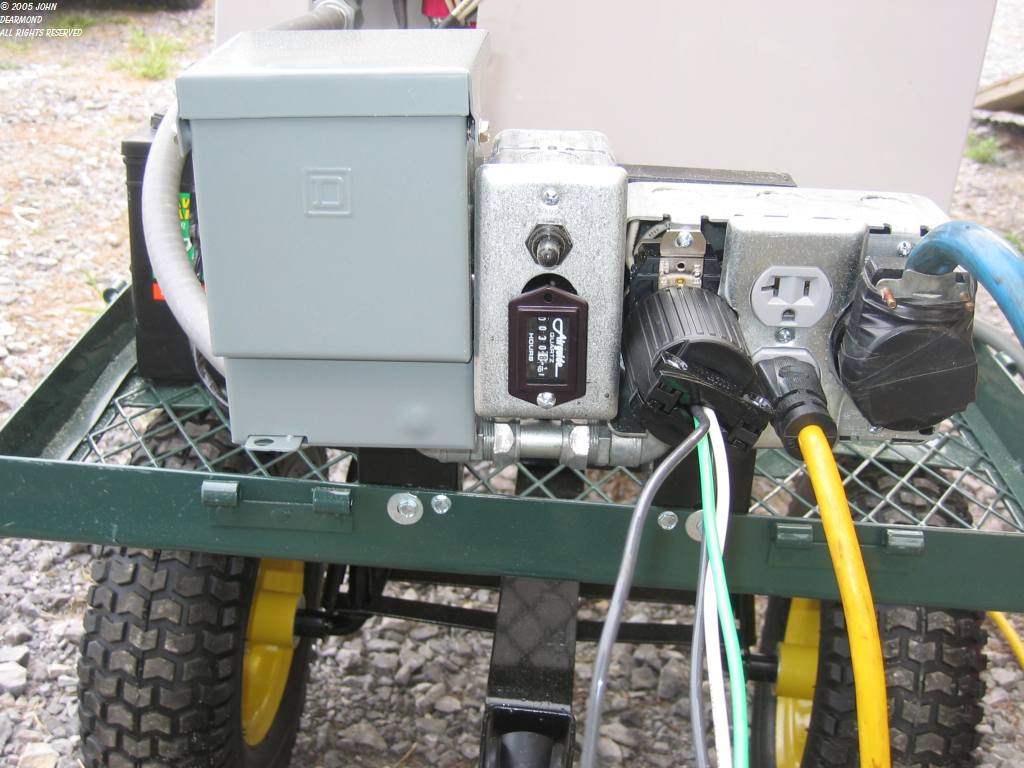
http://www.neon-john.com/Neon_John_site/Generator/Quiet_pack_55G/Quiet_home.htm

John
From: John De Armond
Newsgroups: alt.energy.homepower
Subject: Re: Backflow Emergency Power?
Date: Thu, 08 Jun 2006 01:22:26 -0400
Message-ID: <0obf82l0ot9j2b1nojbjdhj68u7bis8lmq@4ax.com>

On 6 Jun 2006 00:29:55 -0700, "swattsup" <swattsup@gmail.com> wrote:

>Don't forget liability.  I read a post recently (forget where/by who)
>that was to effect - in case there is an injury/death of a lineman who
>in the neighborhood is going to be blamed and sued?  Those with
>transfer switches? Those using extension cords for each appliance? Or,
>someone with a suicide cord plugged into the dryer outlet?

It doesn't matter what bits of hardware you have, if you backfeed and
harm someone, you're liable.  Period.

Backfeeding as a risk borders on what Bruce Schneider refers to as a
"movie plot risk".  Sounds good (bad?) on paper but as a practical
matter it doesn't exist enough to worry about.  For many reasons.
Assume a backfeed path exists:

Unless one has his own pole pig, the load of the other customers on
the pig will instantly trip the generator when it is tied on.

Even if the customer has his own pole pig, the magnetizing inrush
coupled with the capacitive loading of the feeder line will equally
overload and trip the generator.

Assuming for a moment that this didn't happen, unless the feeder going
to that isolated pole pig is itself isolated (by a downed line, blown
primary fuse, etc), the OTHER pigs, PF caps and other apparatus on the
line presents such a load to the generator that it is still instantly
tripped.

Assuming that doesn't happen, the first thing the linemen do when they
arrive at a scene is put on the hot gloves.  All conductors, even
those laying on the ground, are considered hot.  The second thing the
linemen are going to do when they arrive is lay in grounding jumpers.
All purportedly cold lines are positively grounded before any work
commences. When that first grounding jumper goes on, the generator is
instantly shorted and trips or quits.

I acknowledge that there is a tiny, infinitesimal, not-quite-zero
chance that all the odds stack up and a generator somehow, somewhere
will successfully backfeed, that the line crew won't wear their gloves
and they won't lay grounds and maybe someone gets hurt. Never say
never. That's why I teach people how not to backfeed.  But as a
utility engineer who apprenticed in a line crew and who still
occasionally rides a bucket truck, I'm not the least bit worried about
backfeeding.

In a disaster-recovery situation, backfed power is so far down the
list of hazards (switching orders get confused and lines stay hot,
protective apparatus is damaged by the event and malfunctions,
lightning striking near enough to induce hazardous voltage in the
"dead" line, etc) that it isn't worth expending more than passing
thought.  When I follow my training - glove up, ground, gut and
blanket conductors in the vicinity, treat all conductive materials as
hot until proven otherwise, I address ALL those risks at once.

This is, as they say, much ado over nothing.

John
From: John De Armond
Newsgroups: alt.energy.homepower
Subject: Re: Backflow Emergency Power?
Date: Thu, 08 Jun 2006 00:59:28 -0400
Message-ID: <bcaf82hrqu9bvi5i58efu76jq04toou7oh@4ax.com>

On Wed, 07 Jun 2006 05:59:23 GMT, "JoeSP" <olegp@telus.net> wrote:

>
>"Neon John" <no@never.com> wrote in message
>> Hey, spud, show me a transfer switch installed for $100 and yer on.
>> Show me a transfer switch sitting on the store shelf for $100 for that
>> matter, and yer on.
>
>http://www.coloradostandby.com/catalog/product_info.php/cPath/25_27/products_id/1211?osCsid=8ecc09352ebbaae47b8b9ecd42371721

Well now, isn't that special.  Our resident know-it-all proposes a
SINGLE POLE 30 amp RV transfer switch, not approved for non-RV use of
course, for this application.  I wonder if he thinks that it's OK to
sorta ignore that other leg of the 240 volt service.  Assuming that he
would have cited a 2 pole 240 volt 50 amp RV unit had he been slightly
more clueful, let's think this through. BTW, Joe, if you really did
have a clue you'd know that this sort of transfer switch costs under
$60 from RV suppliers.

On one hand we have hero-Joe's 50 amp transfer switch.  On the other
we have our 200 amp service panel.  Hmmm, a slight mis-match.  We
can't break the entrance to insert the switch because a) the switch
isn't approved for that and b) it'd be 4X overloaded.  What to do,
what to do?

Oh, I know, we'll install a sub-panel.  We'll just connect all our
loads that we want supplied to the generator to the sub-panel and
route that through the transfer switch (still ignoring the lack of
approvals, of course.)

But wait, we have a problem.  The careful electrician who wired the
panel cut all the wires to length.  We can't just snake those wires
out of the box and run 'em to the sub-panel - they're not long enough.
We could run jumper wires from the sub-panel back to the main panel
and wire-nut them together using the main panel as a tie-box.  But
that won't work cuz the main panel is already full of wires.  So we're
going to have to put a junction box of some sort next to the main
panel in close enough proximity that the wire stubs can be inserted
enough to splice on the jumpers that go to the sub-panel.

But wait, our main panel is mounted in the wall and trimmed out nicely
so that none of the wiring is visible.  That means we'll have to cut
the paneling, scab in the sub-panel and junction box and then try to
make it look OK when we're finished.

Suddenly it's not just the $99 that Joe's going to spend on the
improper transfer switch.  It's that plus another hundred for the
sub-panel and breakers plus another oh, $50 for the junction box,
hardware and wiring.  Plus the services of a carpenter to try to
salvage something of the wall that looks good after we hack around the
main panel.

See, what has flown past Joe is that we gotta use a 200 amp transfer
switch, not because the generator is going to make 200 amps but
because the NORMAL SERVICE is of that rating.  Further, an automatic
transfer switch is pretty useless in this application because someone
still has to manually shed the non-essential loads so that the
generator isn't overloaded.  A manual 200 amp transfer switch would be
the appropriate device but neither Joe nor anyone else is going to
find one of those new for $100.  Not to mention the cost of
installation, which may be considerable since the meter will have to
be pulled so that the entrance cable can be cut and that usually means
a building permit and THAT means a licensed contractor, at least under
local law.

My adequately safe technique of two breakers, an outlet, color coding
and a checklist is starting to look mighty attractive.  Duh!

John
From: John De Armond
Newsgroups: alt.energy.homepower
Subject: Re: Hooking up Inverter to load center
Date: Thu, 08 Jun 2006 01:38:48 -0400
Message-ID: <o6df82tr9n820rrc6ol2ev6b8ed6u8up2v@4ax.com>

On 6 Jun 2006 19:35:09 -0700, "swattsup" <swattsup@gmail.com> wrote:

>I would like to hook up an inverter to the home wiring through one of
>those generator-type sub-panels.  From what I've read,  it seems that
>most inverters can't handle this.  I'm talking the Vector type
>inverters and not the $2000 Outback types.
>
>I understand that the problem has to do with that the neutral and
>ground are bonded at the load center combined with many inverters have
>the neutral on the output somehow bonded to the input.

The problem is that with some, but not all, cheap inverters, the
switching topology causes ground to become, in effect, the center-tap,
with the hot lead about 60 volts above "ground" and neutral about 60
volts below.  This topology allows the cheap chicom manufacturers save
a couple of semiconductors.  It works fine for the intended purpose
but one of those purposes is not feeding a panel.

You can solve this problem easily enough by simply not bonding the
ground and neutral together when running on inverter power.  "Ground"
has little meaning in this situation anyway, since the inverter output
is floating (to some degree or another) and not referenced to ground.
A sub-panel which by definition must have an insulated neutral block
that is NOT grounded, is the most straightforward solution.  That's
the way I have my motorhome's inverter wired.

>
>Would hooking up an inverter to a 1:1 center-tapped transformer solve
>this problem?  Or even using a 1:2  transformer to get 220 and
>energizing the entire load center? With appropriate disconnects of
>course and realizing you ain't going to power the water heater and
>central AC this way.

yes, this will work with a couple of caveats.  The core loss will
fairly significantly rise, depending on just how crappy the waveform
is, which results in lower efficiency and heating in the transformer.
Some inverters behave badly when presented a highly inductive load, as
the transformer will be when lightly loaded.  I'd not go out and buy a
transformer for this situation.  If I had one on hand, I might try it
but I'd not risk the money on a new one.

>Are there any <$500 inverters (sine wave nice but not mandatory) that
>can handle at least 1k Watts that will work?

Harbor Freight sells a 2kw inverter in the $150 range.  I'd almost bet
that it is of the design described.  The only way to know is to buy
one and test it.


>
>Will a 1500VA computer UPS work as an inverter (ignoring the pitful
>recharge rates they have?)

Probably not.  Most consumer-grade UPSs that I've had the covers off
of don't have the floating neutral problem but they DO have thermal
management problems.  Simply put, they're designed so that there is a
race between overheating and the battery running down.  Usually the
battery runs down first.  Powering the UPS from a larger battery will
reverse the finishing order :-)

A commercial duty one, particularly one designed for an external
battery pack, will probably be OK.  Only way to know is to test the
particular unit you're considering.

John
From: John De Armond
Newsgroups: rec.outdoors.rv-travel
Subject: Re: Using my genny for power outage at home
Date: Mon, 26 Jun 2006 18:48:24 -0400
Message-ID: <nnn0a29c1udq1oat0nc7mmapmrbd58rac2@4ax.com>

On Mon, 26 Jun 2006 14:45:39 -0400, "Eisboch" <rce@nowhere.com> wrote:


>As far as using the main house breaker to isolate commercial power lines
>from a back-fed generator ... not recommended or allowed by most codes.  The
>reason is this.  Most residential breakers are insulation rated for 240
>volts.  In the event that commercial power comes back on while using the
>generator to back-feed the panel, it is likely that the commercial and
>generator power will be out of phase and the voltage potential across the
>open main breaker could exceed it's voltage rating.

The voltage rating is of no concern in this context.  I refer you to
the concept and implementation of BIL (basic impulse level) withstand
to electrical apparatus.  BIL is a measure of the apparatus' ability
withstand overvoltage transients.  I don't recall the specification
for residential apparatus but it is at least 10,000 volts and probably
50kv.

A breaker that could not withstand 480 volts (2 240 volt circuits 180
deg out of phase) open circuit would never withstand the normal
overvoltage transient activity that occurs with any transmission
system.  Nor would it be able to withstand the inductive transient
caused by opening under load or during a fault.  This is a silly
thought to even consider.  Steady-state withstand is probably the
second least stressful condition for a service entrance breaker to
withstand, second only to being completely de-energized.

John
From: John De Armond
Newsgroups: rec.outdoors.rv-travel
Subject: Re: Using my genny for power outage at home
Date: Mon, 26 Jun 2006 22:54:27 -0400
Message-ID: <im41a2hhn70njd74ud0aj93l2kr3fknvn2@4ax.com>

On Mon, 26 Jun 2006 20:14:29 -0400, "Eisboch" <rce@nowhere.com> wrote:

>
>"Neon John" <no@never.com> wrote in message
>news:nnn0a29c1udq1oat0nc7mmapmrbd58rac2@4ax.com...
>
>>
>> The voltage rating is of no concern in this context.  I refer you to
>> the concept and implementation of BIL (basic impulse level) withstand
>> to electrical apparatus.  BIL is a measure of the apparatus' ability
>> withstand overvoltage transients.  I don't recall the specification
>> for residential apparatus but it is at least 10,000 volts and probably
>> 50kv.
>
>Since when?  And are all houses and services built before then retrofitted?

The Coyne Electrical School's Encyclopedia set dated 1946 refers to
BIL rating so I'd have to assume that it has been around at least
since then.


>> A breaker that could not withstand 480 volts (2 240 volt circuits 180
>> deg out of phase) open circuit would never withstand the normal
>> overvoltage transient activity that occurs with any transmission
>> system.  Nor would it be able to withstand the inductive transient
>> caused by opening under load or during a fault.  This is a silly
>> thought to even consider.  Steady-state withstand is probably the
>> second least stressful condition for a service entrance breaker to
>> withstand, second only to being completely de-energized.
>>
>> John
>
>It's nice to read a bunch of specs and regurgitate theory, but it ain't the
>real world.
>There are thousands, if not millions of older breakers, even main FUSES that
>supply power to households.

It's nice to see someone who didn't have a clue about what he was
posting, get caught and wave his arms wildly, trying to deflect
attention.

It doesn't matter WHAT the rating is for the breaker and the fuse
below about 600 volts as far as open circuit withstand is concerned.
Field emission, the effect that causes the ionization trails that
precede a spark breakdown, does not occur AT ALL below between 600 and
1000 volts depending on the surface shape. (I'll be more than happy to
pile you with references if you like and if you think you have a
chance of understanding them.)  That means that even if the gap is
only 0.001", the air gap will not be penetrated by voltage below the
field emission point.  Period.

That's the theory.  In practice because of confounding things like
film and oxide coating on the conductive surfaces, no gap breakdown
takes place until well over 1kv.  One could position the contacts of a
breaker with a separation of a sheet of paper and in the absence of
additional voltage or an external source of ion tracks, no breakdown
at twice line voltage - or even twice that - would happen.  Ever.

In practice, the contact separation is more on the order of an inch,
not so much for BIL considerations as so the blowout coils and deion
grid can extinguish the arc.  Arc extinguishment is a far more
important consideration than static voltage withstand and is what
governs contact separation, insulation thickness, etc. even on little
branch breakers.

In the remote event that you're actually interested in this, might I
suggest "Fundamentals of Gas Discharges", available through
inter-library loan from the Naval Academy library.  That's where the
copy I studied and copied came from.  Another reference book is titled
simply "Gaseous Discharges."  Again, available through inter-library
loan, this time Perdue's library.

>The only way to be sure is to have a proper transfer switch device that does
>not allow genset and commercial power to be applied at the same time.

But we're not talking about that now, are we.  We're talking about
your posting dead-wrong information and when corrected, throwing a
tantrum instead of simply admitting your mistake.  I've watched you
post long enough to know that this is your style but it is still
disgusting.

>You
>might be smart enough electrically to work your way around it, but to
>suggest to that the people that write the electrical codes and circuit
>breaker manufacturers that design and rate them are full of it is a
>disservice to the NG.

I wonder (not really, the answer is obvious, but play along) if you've
ever been on the designing end of things?  On the rule writing end of
things?  I have.  I find the process of modifying the code today
absolutely disgusting, like as they say, seeing sausage being made.

It's been ages since there were any real electrical safety problems
that needed addressing in the code.  Nowadays code content is being
driven by small, very frightened men backed by their lawyers who shake
in the night that anyone anywhere might do anything unapproved.  And
is driven by manufacturers trying to gain an unfair advantage over
competitors by getting their products written into the code,
particularly patented products.  Section 600, the part I've
participated in, is absolutely rife with that crap to the point that a
code-compliant neon installation is both unreliable and dangerous.

So yeah, I do tend to look beyond the code these days.  IT has long
since ceased being a guide that a person with just a little knowledge
could use to do safe wiring.  But that's irrelevant to the matter at
hand.

>You are unwittingly encouraging unqualified people to
>make homemade modifications.  Frankly, I take *your* statements of knowledge
>as being both silly and dangerous.

I'm neither do anything unwittingly nor am I encouraging anyone.  I'm
showing people who have the necessary knowledge how to safely do thing
in alternate, usually less expensive ways.  I know that this drives
people like you crazy who not only can't think outside the box but who
consider the box a rigid barrier to thought but frankly, I don't care.
In fact, I enjoy watching you writhe.

I believe in free will and personal responsibility.  If someone
exercises his free will by following my description of things that
I've done and HE screws up then it is HE who is responsible for his
actions.  Just as if I were to follow Boydisms and blow myself up then
it would be on MY head and not his.  It is MY responsibility to
identify the idiotic advice and ignore it.

I know, strange concept in this era of cradle-to-grave NannyGov but
there it is.

John
From: John De Armond
Newsgroups: rec.outdoors.rv-travel
Subject: Re: Using my genny for power outage at home
Date: Mon, 26 Jun 2006 23:13:18 -0400
Message-ID: <mr71a293tq0lqfdekenlsbonosgvvjnua5@4ax.com>

On Mon, 26 Jun 2006 20:55:57 -0500, Gordon <gordon5056@charter.net>
wrote:

> Anyway, here is something
>that happened to me a couple of years ago repairing storm damage.
> I was repairing a rural 3 phase line that had a tap running off
>to a farm house. I was using grounds and gloves. I finished my repairs
>and was taking off the grounds. At the same time I was doing this,
>a farmer energized the tap feeding into the three phase lines with
>a 20 KW PTO generator. This momentarily saturated the transformer.
> I removed the ground and got a flashover that made me sit down in the
>in the bucket for a minute or two before I could see anything at all.

I had a similar one happen less than a year ago.  I was out with a
crew who was repairing a main 14.4kv 200 amp feeder not too far from
the substation.  this wasn't storm damage but burned lines caused by
lack of right-of-way maintenance letting a tree get in the conductors
and burning one.  The feeder was dead and grounded and the work
completed.  The foreman made the mistake of asking HIS supervisor (who
had been a lineman and knew better) to go back to the sub and wait by
the radio to energize the feeder.

Instead of waiting by the radio, this guy strolls in and immediately
punches the breaker live.  At the same instant, one of the guys was
removing the last ground clamp.  It was off the line but close enough
to arc.  Vigorously.  The protective relaying at the sub didn't work
and the conductor ended up burning down again.  The clamp on the
ground lead and the end of the stick were just gone.  We were all
flash-blinded pretty good for awhile but because everyone was
following procedures, including gloves and manipulating the ground
clamp on the end of a 10 ft hot stick, no one was even slightly
injured.

Two similar events and because everyone followed his training (except
the supervisor, of course), no one was hurt.  That's the way it's
supposed to be.

I probably came down a bit hard on your post but it was the straw that
broke the camel's back.  I've heard that bit about backfeeding, on the
net and off, once too often in the last couple of weeks and I just had
to say something.  No need to run off.  Just stick to RV subjects and
few flames will fly.  Advice that I need to try to follow more closely
to 100% than I do now.

John
From: John De Armond
Newsgroups: rec.outdoors.rv-travel
Subject: Re: Using my genny for power outage at home
Date: Mon, 26 Jun 2006 16:19:37 -0400
Message-ID: <4rf0a2h48go0hedsiv16vk82p6nn64ennn@4ax.com>

Oh, that's not hard.  I've seen many varieties of cobble-together
wiring that does that.  A very common situation is where someone
installs a sub-panel that usually doesn't have a main breaker but
cheaps out, doesn't include a disconnect and sticks the wires directly
under the main lugs on the main box.  Voila!  Instant always-hot
sub-panel.

That situation is reasonably safe as far as overload and fire goes but
I've seen worse.  Like 14 gauge wire stuck in the main lugs because
the box was out of breaker slots and the guy just had to have another
branch.  Or several branches dog-nutted (split-bolt connector) to a
hunk of, say, #4 which, in turn, is stuck in a main lug.  Not only
does it stay hot when the main is opened but there is no overload
protection at all.  I found that in my first restaurant building when
I first walked through.  Naturally I fixed it before the power was
ever turned on!

A fully code-compliant (at the time) installation that doesn't have
one main was the wiring installed in my house after the fire.  I
wanted 400 amp service so the contractor installed 2 200 amp boxes
side by side, each with its own drop from the metering current
transformer.  There was a main breaker in each box.  Fully inspected
and accepted by the Cobb County electrical inspector and apparently,
common practice.

John

On Mon, 26 Jun 2006 14:53:07 -0400, "Steve Wolf" <news@w8iz.com>
wrote:

>A main breaker that doesn't shut off the box?  Please, electricians, tell me
>about electrical boxes in which the main does not kill the box.  Leave off
>the NEC stuff.  I'm more interested in those who can explain the reasons.
>
>It appears to me that the main should shut off the electricity ... by
>definition.  If not, it is not a main.  It might be a main to a set of
>breakers, but not a main the house.
>
>Steve
>www.wolfswords.com under the motorhome link
>
>> You need to be sure that turning off the main breaker in fact turns off
>> everything. In my home it doesn't. The buss bars are still hot in part of
>> the box. I have to pull the meter off  to isolate the hots when I plug
>> directly into the house wiring. 1 of these days I may buy a relay switch,
>> but so for, have had no squak from the power company when I call them and
>> tell them the meter needs a new seal because I was powering during the
>> outage with a generator.
>
From: John De Armond
Newsgroups: rec.outdoors.rv-travel
Subject: Re: Using my genny for power outage at home
Date: Mon, 26 Jun 2006 18:58:15 -0400
Message-ID: <l6p0a2pgs5cj8opfhtg9kqc17q193pt02t@4ax.com>

Now that you mention it, I'm pretty sure I've seen one of those Square
D boxes.  The "main" is just another breaker in the row.  The service
entrance feeds a copper bus that the "main", the "range" and "furnace"
breakers (or fuses) feed from.  I can't recall if it was in my
parents' first house or one of the jobs my dad worked on where he let
me tag along.  Seems like the box was old in the early 60s.

I do know that back then it was common for electricians and handymen
(homeowner or otherwise) to pull the meter to de-energize the
electrical system.  The local utility didn't pay much attention to
meter seals and would rarely replace one.  Back then they didn't waste
time on addressing problems that didn't exist and since power theft
wasn't a significant problem, no need to go ape-sh*t over seals.

John

On Mon, 26 Jun 2006 20:40:55 GMT, "Tom  J" <tomnews@earthlink.net>
wrote:

>Will Sill wrote:
>
>>
>> For once I agree wholeheartedly with Steve.  If it doesn't open BOTH
>> (all) incoming lines, it ain 't a main!
>
>I also agree, BUT these boxes have it markd in large letters and also
>moulded into the handle - MAIN.  That's the reason I pointed this out.
>The boxes in my subdivision were made by Square D and furnished and
>installed by the power company. The way I learned about these boxes
>was 1 of my neighbors burned out a generator hooking up without
>pulling the meter or putting in a relay box. Luckly for the power crew
>the incoming line was broken and grounded between his house and the
>transformer.
>
>Tom J
>
From: John De Armond
Newsgroups: rec.outdoors.rv-travel
Subject: Re: Using my genny for power outage at home
Date: Mon, 26 Jun 2006 16:08:11 -0400
Message-ID: <tfe0a2h23kcd597dn60fbsi9ar38ojg05r@4ax.com>

On Mon, 26 Jun 2006 17:32:27 GMT, "Nate"
<nsaptaemcpcrnonof@nvbell.net> wrote:

>We had 5 hours of power outage on Saturday at home.  I headed to Home Depot
>to pick up a couple 50 amp plugs to splice together so I could plug the
>house into the genny in the RV.  I was going to turn off the main breaker so
>as not to run voltage back into the supply and zap the guys working on
>restoring power.  I figured I'd just plug into the outlet that the RV plugs
>into to feed power back to my main panel.
>
>Got home and the power was restored.  Cool!
>
>Then I examined my plan further.  I forgot that my plug in is a 30 amp plug
>and I use a dog bone 30 to 50 amp adapter.  If I were to set this up and
>plug my 50 amp 7500 genny into the 30 amp adapter...what happens?  My
>thinking is that A.) I only power half the house.  And B.)  I am running two
>phase power into single phase...which could potentially blow things up.  Am
>I right?

Nothing personal but ummm, this is scary that you almost did it
without knowing the answers to those questions.

First off, residential power is NOT 2 phase.  It is dual voltage,
single phase.

I think that I understand you to say that your generator is 120 volt,
30 amp capable.  If that is the case then if you wired it to the
breaker panel with no other mod, you'd power up half your house and
would undervoltage and probably damage your 240 volt loads - if the
generator didn't trip on overload.

IFF you understand fully that you MUST open the main breaker before
attempting any of this then there is a way.

I have my concession trailer set up to work on either 120 or 240.  It
is wired as with a subpanel in a house - a conventional 240/120 panel
with a main breaker and an isolated neutral, 4 wires running back to
the 240/120 volt generator or outlet.

When 240 volt power is available, the system works conventionally,
with 120 volt loads spread out across both legs to minimize neutral
current.

When 120 volts only is available, I flip the brightly red painted
breaker at the top of the row which shorts the two legs together so
that they run in parallel.  There is a wire that runs from the
breaker's output terminal over to the OTHER leg's main lug. Now
everything runs on the one leg and the neutral handles all the return
current.  It's designed for 30 amps service so the wire can handle it.

Since I'm the expert on my system and I'm the only one who operates
it, this works fine for me.  If I occasionally forget and leave the
bright red interconnect breaker on when I plug to 240 volts, it very
quickly trips, as it presents a short circuit.  I would NOT do it this
way if anyone else could ever operate the system.

An alternative that is safer is to connect the legs together inside
the 4 wire socket on the adapter cord.  You'd make up an adapter cord
that has the 30 amp plug on one and the 50 amp (twistlock or range)
plug, both male, on the other and connect the two with 10-3,
preferably SO cord.

In the female 50 amp socket, put the green wire on the ground socket
lug, the white wire on the neutral, the black on one hot lug and run a
jumper over to the other hot lug.  The 50 amp female plug would be
connected to the breaker panel conventionally using 10-4 wire.  It can
serve as an outlet for your welder or whatever conventionally and as
the power receiver during an outage.

Yes, the adapter can have hot prongs on it but that's the nature of
the beast doing it on the cheap.

I have used a similar system for years at my cabin in the mountains. I
have a 75 ft length of 8-4 SO cable wired to the panel with a male 50
amp twistlock plug on the end that fits my generator that is on
wheels.  When not in use the breaker is off and a female connector is
mated to the plug to prevent the prongs from being exposed.  I simply
open the main, flip the red breaker, connect and crank the generator
and I'm up and running.

Last weekend I discovered where all the Harbor Freight returned items
go - to a city-block-sized former sewing factory in, of all places,
Etowah, TN. I drove past last weekend on the way to my cabin, saw the
junk on the sidewalk and stopped.  !WOW!  Acres of ChiCom orange
stuff.  I picked up one of those Culter-Hammer generator transfer
switches that HF sells for $300 for $75.  Now I'm going to do my cabin
correctly :-)  Sorry, the store isn't on the web and they don't accept
credit cards - only cash and checks.

John
From: John De Armond
Newsgroups: rec.outdoors.rv-travel
Subject: Re: Using my genny for power outage at home
Date: Mon, 26 Jun 2006 19:20:16 -0400
Message-ID: <vpp0a2ddh21cvjkfg7ah99157gm1ns9prn@4ax.com>

On Mon, 26 Jun 2006 20:19:34 GMT, "Nate"
<nsaptaemcpcrnonof@nvbell.net> wrote:


>> First off, residential power is NOT 2 phase.  It is dual voltage,
>> single phase.
>
>Split phase.  Right?

RORT is the first place I ever heard the term "split phase" applied to
the utility power.  "Split phase" refers to a type of single phase
motor where the phase shift necessary for rotation is created either
by a capacitor, a shorted turn on the pole or sometimes just the
winding configuration.  The ordinary capacitor start motor such as is
on a well pump, pool pump, inside AC compressors and the like is a
split-phase motor.

I don't know of any catchy phrase that describes incoming power.  I've
actually spent some time in the past looking through my reference
books to see.  The only notation I know is the actual voltage,
"120/240", "120/208" etc.  The reason is that the voltage can derive
from several configurations other than a center-tapped single phase
transformer as most of our homes have.  For example, 208/120 comes
from adjacent legs of the three phase bank.  One phase delivers the
120 volts and two adjacent phases deliver the 208.  This isn't a split
transformer at all.

>
>>
>> I think that I understand you to say that your generator is 120 volt,
>> 30 amp capable.
>
>It is 120 volt, 50 amp capable.  Which I originally thought it was capable
>of delivering 240 volts, but others have corrected me and the manual agrees
>with them.

You didn't mention what generator you have but many RV and portable
generators including my Generac QuietPack can be strapped for either
120 or 120/240 service.  Mine came strapped for 120 only but I
re-strapped it to feed my concession trailer.  If you want it both
ways it's a simple matter to install the appropriate switch.

The generator has two winding.  For 120 only service, they're wired in
parallel.  For 120/240 they're wired in series with the center point
being the neutral.

Generac made re-strapping very easy by bringing all 4 leads up to the
junction box.  Others might require removing the end bell to get at
the internal connections.

Given a choice I'd rather have 120/240 out of the generator because
you don't have to do anything hinky with the wiring and you CAN run a
240 volt load if you have to.

John
From: John De Armond
Newsgroups: rec.outdoors.rv-travel
Subject: Re: Using my genny for power outage at home
Date: Mon, 26 Jun 2006 23:26:14 -0400
Message-ID: <2s81a2hh42700lvu3vckeffoeka6tco9j1@4ax.com>

On Mon, 26 Jun 2006 20:26:12 -0400, "Eisboch" <rce@nowhere.com> wrote:


>"Split Phase" is a term sometimes used, perhaps inaccurately, to describe
>the type of power the utility company delivers to your house from a center
>tapped transformer.  Because it's not 2 phases of a three phase service (wye
>or delta) the term is used to describe two, out of phase legs and a neutral.

Like I said, I've only ever seen this "split-phase" term used
(incorrectly) on the net.  120/240 can be derived from many odd ways
that don't involve splitting anything.  For instance, I saw in a
foundry once an autotransformer that took in the 600 volts from the
distribution and had taps at 480 for the machine's motors, 240 for
some heaters and 120 for the convenience outlets inside the cabinets
and to run the instrumentation.  The 120/240 was piped through a small
conventional breaker panel.  The whole distribution system was of the
ungrounded type and this connection became apparent to me after my
test equipment malfunctioned and I found several hundred volts on the
neutral to ground.  I had the client install a conventional dry 1:1
transformer in the feed to the panel and all was well.
>
>Got a question for you John.  In a house service of, say 200 amps per leg,
>how many amps must the neutral leg be capable of carrying?

200 amps, of course.  Now my question.  Were you asking this because
you didn't know or were you hoping I'd trip up and say 400?

John
From: John De Armond
Newsgroups: rec.outdoors.rv-travel
Subject: Re: Using my genny for power outage at home
Date: Tue, 27 Jun 2006 12:54:01 -0400
Message-ID: <dqm2a29u3nhrvr5rosmllosi47bn201fe0@4ax.com>

On Tue, 27 Jun 2006 05:56:36 -0400, "Steve Wolf" <news@w8iz.com>
wrote:

>>> 200 amps, of course.  Now my question.  Were you asking this because
>>> you didn't know or were you hoping I'd trip up and say 400?
>
>John,
>
>So in generators that are producing two independent sources of 110 volts
>(like our generators, or at least mine), then one must assume that the
>neutral might at some point have to carry BOTH legs, right?  This seems
>obvious but so did Eisboch's comment about flashover.

Two independent generators can't produce the 120/240 volt power like
we're discussing because they run at random speed and relative phase.
The only way to do that would be to mechanically lock the two shafts
in the proper mechanical phase orientation.  I've seen a military
generator done that way, probably for space savings but that was
unique.

If we strapped two independent generators together via common neutrals
and then ran two sets of 120 volt loads with the idea being to save a
conductor by sharing the neutral then the neutral current would
cyclically vary from zero when the two generators are 180 deg out of
phase to the sum of their loads when they are in phase.  This cycle
could be very fast or creeping slow, depending on the speed difference
of the two generators.

This does not, of course apply to inverter generators.

There was a long discussion on the alternative power group a couple of
weeks ago on if or how two Honda EUs could be strapped together to
make 120/240 volt power.  Short answer was, no simple and easily
provable method exists.  One of the EE university types proposed a
scheme, if I managed to understand his ASCII graphics correctly, that
would use a small transformer to reverse the phase of one generator
relative to the other.  I don't know whether that would work and I'd
certainly not risk it on an EU without a lot more testing.

My suggestion to the guy which is a generic, if heavy, solution is to
get a small dry transformer with a 2:1 ratio and the high side center
tapped.  Strap the generators together in parallel using the usual
synching procedure, then feed that high amperage 120 volt power to the
transformer and get conventional 120/240 out the other side.


>
>In what device would one find a deionizing grid or a coil to defeat
>ionization?  Large breakers?

Even branch breakers have a rudimentary form of both.  The blowout
coil is usually just part of the conductive path oriented to generate
the proper magnetic field.  The deion grid is usually just a series of
ribs cast in the Bakelite.  These little breakers are generally
limited to 10k amps or less fault current interrupting capability. the
construction of the breaker panel is designed to insert enough
impedance into the circuit to limit the fault current to below that
regardless of how "hard" the incoming supply is.  And you though those
cheap-sh*t looking bus bars were that way only to save materials :-)

These features get more refined as the breaker's interrupting
capability (not its rating) rises.  A 10 amp breaker with a 100k amp
interrupting capability will be the size of a stack of paperback books
and will have both wound blowout coils and deion inserts consisting of
pressed mica sheets interspersed with (usually) brass grids.  The idea
is to break the arc up into numerous small arcs that can be more
easily quenched and blown out.  The blowout coil directs the arc into
the arc chute where it encounters the deion grids.

DC breakers get even more serious about this because the DC circuit
doesn't have the periodic zero crossings to help quench the arc.  The
arc chute and deion grid typically take up a large portion of the
breaker internals.

I noticed an interesting thing several years ago.  Some DC contactors
and breakers started appearing with polarity or current direction
markings.  That seemed odd since a switch isn't polarity sensitive.
Then I learned that several manufacturers have started substituting
permanent magnets for blowout coils.  For the PM to repel the arc in
the right direction, the current must be flowing in the right
direction.  Ergo the markings.

John
From: John De Armond
Newsgroups: rec.outdoors.rv-travel
Subject: Re: Motorhome Generator as Emergency House Power
Date: Thu, 21 Dec 2006 22:17:45 -0500
Message-ID: <4iimo2ptddkjj5mjpr6gu8pnsrehdj4389@4ax.com>

On Thu, 21 Dec 2006 16:35:46 -0500, HD in NY
<hbdandvsd@nodamnspamyahoo.com> wrote:


>I can. A break in power that lasts for several days to weeks would
>prompt me to break the seal and pull the meter. If both power and
>phones were out for an extended time period you have a choice. Leave
>your house and seek shelter someplace that still has power or stay and
>jerry rig power.
>
>Pulling the meter and hooking into the house circuits will give you
>power to all 120v circuits. Presuming you have the balls to pull the
>meter and the expertise to hook the genset into the house circuits
>would also presume you'd have the good sense to notify the power
>company you'd pulled the meter and let them put it back.
>
>I doubt most readers would have the expertise to do any of the above
>and the advice to hire a professional is valid.
>Hugh

There really isn't any need to pull the meter.  IF you're
jerry-rigging, simply open the main breaker and then attach the
generator to the box downstream of the breaker.  The way I do that is
with another 1 or 2 pole (depending on whether I'm feeding 120 or 240
volts) breaker with power fed backwards, in thru the output terminals.
The breaker works equally well either way.

In fact, that's pretty much what that low budget transfer interlock
thingie that Steve Wolf has mentioned a couple times.  It involves
installing another breaker in the box to receive power from the
generator and a mechanical linkage to ensure that both can't be closed
at the same time.

If you're REALLY jerry-rigging, no need for the breaker.  Just open
the main and then, using a couple of small vice grips, clamp the
generator feed wire(s) to the breaker panel bus(s).

In fact, in my box of "power thieves" is something similar. A 16L-30
twist-lock socket on one end of a length of 10-4 SO cable and on the
other is attached a small pair of insulated vice grips to each lead. I
most commonly used that by climbing the temporary power poles
typically set up for special events and grabbed onto the service drop.
Hot gloves required, of course.  I will have to admit to having gotten
some interesting looks and comments.... Having a lineman's hooks, belt
and hard hat does help avoid the more pointed questions....

Being set up to feed your panel from alternate sources comes in handy
under all sorts of conditions. For example, after a storm dropped a
tree across the service drop of my neighbor in Tellico and the CoOp
told him it might be a week before they got up there to fix it, I fed
him off my box.  I had a roll of 4 gauge triplex (the twisted stuff
that feeds power from the pole to the service entrance) that I strung
on the ground between our houses.  It connected to a 100 amp breaker
in my panel and a similar one in his.  Since neither of us use
anywhere near 100 amps, it worked just fine. I didn't even ask him to
pay for the power :-)

John
From: John De Armond
Newsgroups: alt.energy.renewable,alt.solar.photovoltaic,alt.energy.homepower
Subject: Re: Small grid-tie inverters?
Date: Sat, 28 Jun 2008 09:55:42 -0400
Message-ID: <dagc645s4okbmliji8rb29jv28avd9f5p7@4ax.com>

On Fri, 27 Jun 2008 17:11:06 -0500, z <z@yada.yada.com> wrote:


>>> You're kidding, right?  250 watts wouldn't even supply the
>>> magnetizing power for the first pole pig, much less charge a few
>>> hundred feet of primary's capacitance.  It probably wouldn't even
>>> supply the phantom loads in the house itself.
>>
>> this sounds pretty accurate. The inrush current to even power on a
>> small distribution transformer is extremely high and would make any
>> small inverter just shut down thinking it was shorted out.
>>
>
>you guys are probably right.
>
>I just remember several times during my wildland firefighting days seeing
>down lines and hearing over the radio 'yeah they're not hot' and hoping
>some asshole hadn't plugged in a generator somewhere down the line as we
>began hitting the area with water.

I'm a retired utility engineer and before that a lineman. IOW, a little
experience in this area.

A couple of comments.

ANY wire that you can't clearly see both ends of is considered hot until
rendered safe with grounds.  As a lineman, I'd never touch even a downed guy
wire without my hot gloves on.  If someone was telling you that a line was OK
because it wasn't hot, that person had a death wish for you.  Even if the line
were dead at the moment, it could go hot at any second, either automatically
or because someone made a switching mistake.

Other comment:  Water isn't conductive enough to present a shock hazard from a
fire hose or something similar even if the line is hot.  It was a routine
practice to use fire hoses down live 500kV insulators at the power house
switch yard to remove crud buildup.  I couldn't believe it the first time I
saw it but I learned that it is a routine procedure.

Now if you were using one of those back pack water bladders that the hotshots
use, different story.  You don't want to "pee" on the power line!

John
From: John De Armond
Newsgroups: alt.energy.renewable,alt.solar.photovoltaic,alt.energy.homepower
Subject: Re: Small grid-tie inverters?
Date: Sat, 28 Jun 2008 17:57:59 -0400
Message-ID: <98bd64p09k6opli2sb15hcuu8sfpvipmlt@4ax.com>

On Sat, 28 Jun 2008 20:12:42 GMT, Bruce in alaska <fast@btpost.net> wrote:

>In article <g43db0$mkm$1@reader2.panix.com>,
> Cydrome Leader <presence@MUNGEpanix.com> wrote:
>
>> this sounds pretty accurate. The inrush current to even power on a small
>> distribution transformer is extremely high and would make any small
>> inverter just shut down thinking it was shorted out.
>
>Just a Note here, When we are considering Islanding and Backfeeding,
>one thing to consider IS, that if some Yahoo does "accidently" Plug
>his 2Kw Genset into a house with the Main Breaker Still on during
>an outage, it isn't the 2Kw of power that is going to travel back up
>the Distribution System, but the Voltage Spike that that 2k Genset
>is going to cause, untill either it's internal Breaker Trips, or the
>Magic Smoke pours out of the Genend.  It will be the spike that
>zaps the folks up the line.  Yes, ALL Linemen, know what Grounding Staps
>are for, and use them, as well as Hot Sticks, Hv Gloves, and all the
>other protective gear associated with Power Transmission Systems,
>BUT, the NEC REQUIRES Transfer Switches and Anti-Islanding Devices
>for a reason, and it IS really, Safety Related.

Well, there's safety and there is blind dumbshit idiocy that ignores common
sense masquerading as safety.  Much of the NEC is in that category.

Before a 2kW generator can do anything to that lineman down the road who is
careless enough to be handling a conductor without his gloves and without
grounds, it first has to power up the house, any other houses connected to the
pig, the magnetizing current of the pig, the capacitance loading of the
primary, the magnetizing current of any other pig on the "island, any other
houses on any other pig, etc, excess...

Ain't gonna happen.  What the generator sees is essentially a dead short. With
most small generator designs, the field de-excites and the generator does
nothing.  The only time that islanding is even a remotely credible hazard is
if someone is at the end of a long primary line in a rural setting and the
primary line is downed near the pig feeding the facility.  A large farm might
fit that description.  A large farm is likely to also have a PTO-driven or
stationary 20kW or larger generator.  Even if he did manage to backfeed and
energize the primary, when the first lineman on the scene does what every
lineman is trained to do automatically, secure grounds, the generator is
dead-shorted.

That's really not what this thread is about since we were discussing a 250
WATT inverter and not a 2kW one.  There has been so much yammering that I
decided to do an experiment.  I went down to my shop and rolled out a 20kVA,
14.4kV pole pig (doesn't every shop have one or two?)  I don't have a 250 watt
inverter but I do have several 350 watt ones.

The experiment consists of hooking the inverter to a pair of 100 amp-hour 12
volt deep cycle batteries in parallel to make sure there is enough inrush
available on the 12 volt side.  A 120 volt Jesus cord runs directly from the
inverter to the neutral and one hot leg of the pig's secondary.  The primary
is unconnected except for a short jumper leading over to an electrostatic
kilovoltmeter.  An electrostatic meter has infinite impedance and presents no
load.

I did 10 shots.  That is, with everything wired up, I flipped the inverter
switch to "on".  Ten out of ten times the inverter tripped instantly.  The
voltmeter didn't move a bit.  I guess that I could have hooked a scope and HV
probe to the primary but it wouldn't have told me much more.  Obviously the
inverter's protective circuitry trips it off long before it can complete even
a single cycle.

I tried the same experiment with a 1.5kW inverter that I had handy.  Same
result except that I could see just a blip on the electrostatic voltmeter.
Maybe a half-cycle of output completed before this inverter shut down.

This pole pig is extremely efficient.  I once measured the standby losses.  I
don't recall the exact number but it was something tiny, on the order of 10
watts or so.  HOWEVER!  It needs several kVA of magnetizing "wattless" power.
That's the demand the inverter sees and can't supply.

This experiment on a pole pig with NOTHING attached to it shows just how silly
it is to be discussing back-feeding from a 250 watt inverter.

I know from other experience that it is very difficult, almost impossible, to
energize this pig even from a 7kVA generator by closing the breaker once the
generator is up to speed.  That makes it kinda difficult to feed a large
Jacob's ladder from the generator.  The only way that I can make it work is to
close the breaker before starting the generator.  Then, most of the time, they
come up together.

John
From: John De Armond
Newsgroups: alt.energy.renewable,alt.solar.photovoltaic,alt.energy.homepower
Subject: Re: Small grid-tie inverters?
Date: Wed, 02 Jul 2008 10:38:44 -0400
Message-ID: <tj3n645gr94vdm8bhei14ga6mt309sm4rb@4ax.com>

On Wed, 02 Jul 2008 03:11:52 GMT, "Don Kelly" <dhky@shaw.ca> wrote:


>-------------
>The data is questionable  as to whether there is meaningful accuracy of the
>meter at low currents and low power factors as would be the case for
>exciting this  transformer  (unity pf at 100V??? and 94VA at 120V,0.89A,

Not really.  AT that low excitation level, hysteresis in the core or plain old
dissipation in the high voltage dielectric could account for the high pf.  I'd
lean toward dielectric dissipation.

>but the conclusion that the inverter isn't going to do much  is correct.
>However, having excited the transformer, there will be potential on the high
>side and sufficient reserve capacity of the inverter  to deliver a
>noticeable (not nothing),  but  not normally lethal, shock to anyone in
>contact with the high side. Of course if the linesman follows proper
>procedure, he wouldn't get a shock but the inverter could be toast.

Nah, the inverter will simply shut down, like it does when presented with any
other short.  But you touch on another are where the safety idiots are running
on blind ignorance.

First a little math.

250 watts at 14,400 volts (a common distribution voltage) is 0.017 amps or 17
ma.  That's assuming that the pig is 100% efficient and that the inverter can
actually power up the pig, two things that we know are not true.  But let's
pretend.

Consider 17ma.  Automotive ignition systems produce more current than that.
Oil burner ignition transformers are typically 20 ma.  Neon sign transformers
are commonly 30, 60 or 120 ma at up to 15,000 volts.  Literally thousands of
people a day get zapped from all of these sources and have little to show for
it other than a sheepish grin and maybe wet underwear.  As a neonist, I've had
my share of "illuminating" experiences at the hands of neon transformers.  I'd
rather not experience that ever again but OTOH, I'm not going to cower in the
corner in fear of a few ma of high voltage current.

<we shall now pause for a moment for the safety panty wetters to quote how
much current through the heart it takes to kill, yada yada yada.  Then we take
another moment to observe that the current has to get to the heart before it
can do anything.  There's a reason why defibrillators dump 400 joules or more
of energy and literally amps of current into the paddles and it ain't to help
send big capacitor manufacturers' kids through college.>

This whole thread was born of ignorance and perpetuated by the petty
authoritarians who don't actually have any technical learning but who want to
tell others what to do anyway.  Such a waste of time.

John
Index
Home
About
Blog