Index
Home
About
Blog
From: John De Armond
Newsgroups: rec.outdoors.rv-travel
Subject: Re: Generators
Message-ID: <t2h7fvg4133f5592afbfb3cfnsj74p2m2l@4ax.com>
Date: Fri, 20 Jun 2003 22:51:29 -0400

On Fri, 20 Jun 2003 15:58:56 -0400, "Sam Hopkins" <samuel.hopkins@marconi.com>
wrote:

>So A/C's need 40-60 AMPS to start?

or more.

If you want to know what your AC draws, climb up, take the cover off and find
the compressor nameplate.  Usually a metal tag welded on the can, though some
mfrs are now using stick-on labels.  Look for the "LRA" (locked rotor amps)
spec.  That tells you what the compressor draws until the rotor is up to a
significant fraction of its operating speed.  My 13.5kbtu Coleman has an LRA
spec of 60 amps.

The generator must supply that current for a significant part of a second,
sometimes more when it is very hot outside.  Traditional constant speed
generators supply the amps from inertial energy stored on the rotating mass.
Inverter generators can't rely on that because the engine is not rotating at
high speed when the compressor is turned on.  Plus the (usually FET) switches
in the inverter must be capable of passing that much current.

I recently replaced a thoroughly worn out Onan AJ generator in my rig with an
inverter generator.  I tested the AJ before removing it.  The engine was so
worn that it could barely make 1500 watts continuously.  Yet it still started
my AC with nary a bother.  Why?  The rotating mass, and thus the inertial
energy storage, remained the same even as the engine wore out.  Many times in
hot weather it could start the AC but could not keep it running after the head
pressure built up.

The limitation of the Honda inverter generators in particular is that they are
severely limited in surge capability.  Exceed a certain instantaneous current
value and the protective circuits instantly shut down the inverter.  IMHO,
Honda set the limit too low, probably to permit using smaller/cheaper FETs
and/or a smaller package.  My Generac unit, OTOH, has started anything I've
plugged into it that was within its continuous wattage rating.  That includes
a 2 hp air compressor.  The inverter uses huge FETS (of course I took it apart
to see how it worked before installing it :-) and massive heat sinking,
probably more than necessary.

My speculation is that Honda designed the 1 and 2kw EU series for casual and
standby use and did not design in the reserves (and corresponding weight)
needed for motor loads.  I'd guess that most applications involve running
lights and/or a TV, something the EUs are ideally suited for.
From: John De Armond
Newsgroups: rec.outdoors.rv-travel
Subject: Re: Honda EU3000i
Date: Wed, 24 Sep 2003 13:55:52 -0400
Message-ID: <vcm3nvoqopibhs699uk4bgiu29d70mjg80@4ax.com>

I haven't had a chance to take an EU apart yet but on my Generac, the
alternator output is at a couple hundred volts, depending on engine speed.
The "inverter" is simply a MOSFET chopper feeding a large LC lowpass filter.
It PWMs the generator output to the 120 volt, 60 hz output.  The computer
keeps the engine at the appropriate speed for the load.  The rectifiers are in
the control module.

I would expect Honda to do the same thing, for a chopper is vastly simpler and
less expensive than a PWM inverter.  High voltage, low current generation is
more efficient because of the lower I^2R losses, everything else being equal.

John

On Wed, 24 Sep 2003 15:29:49 +0000 (UTC), "CampinGazz" <Nosp@m.ta> wrote:

>
>"TBFisher" <tbfisher@hotmail.com> wrote in message
>news:pa6cb.2987$Nx5.2026671305@newssvr12.news.prodigy.com...
>>    I assume that these units use an alternator to
>> drive the inverter. I wonder what the voltage
>> output of the alternator is? If adjustable to the
>> 12-15V range maybe the output could be used
>> to charge batteries directly and not use the inverter.
>> Seems this would be more efficient to charge batteries
>> as Neon John has discussed. A 1000-1500watt model
>> would probably be ideal and very quiet.
>
>From what i've heard of the honda inverter gennies, the alternator dosent
>have the diode stage in it, so feeds the 3 phase AC to the inverter, and at
>something like 40 or so volts.. prolly 48 volts, going on ohms law.. where a
>1000 watt inverter would pull 100 amps from the input side at 12 volts, it's
>pull 50 amps at 24 volts and so on, so it makes sense to use a higher input
>voltage to make the alternator smaller,
>
>i'd like to get one of these gennies and just use the engine to drive a
>normal automotive alternator through a 4 stage charger, like neon john does
>but having the quietest engine available.
>
From: John De Armond
Newsgroups: rec.outdoors.rv-travel
Subject: The Case against Inverter Generators
Date: Thu, 04 Dec 2003 14:20:31 -0500
Message-ID: <mrtusvoun1vup3j015mjtghqvicm77p7db@4ax.com>

Imagine you're out in the weather and you're cold.  The temperature is in the
40s and the wind is blowing.  You have your little 1kw generator and plenty of
fuel.  You also have a 1200 watt coffee maker and a 1500 watt heater.  What to
do?

If my generator is one of the popular Honda or other brand inverter generators
and I plug my heater in, the generator will promptly trip on overload.  OTOH,
if my generator is a conventional sync generator, it is possible that the
generator will handle the overload and provide some heat.  Maybe not full
output but some.

This is the situation I found myself in at the Daytona Speedway Turkey Rod Run
last weekend.  I had my little electric scooter and the trailer.  I had
strapped my new 1kw Chicom generator to the trailer along with a battery
charger and a ceramic heater.  The temperature was in the low 40s and the wind
was blowing a steady approx 20 mph.  Cold as h*ll with summer clothes on.  It
has been in the 80s the day before.

I had purchased a package of tarps in the flea market so I found myself a
place along a guardrail and set up an impromptu lean-to.  I cranked the
generator and plugged in the heater.  The generator loaded down.  Way down.
Probably wasn't producing more than about 50 hz power.  But it WAS producing
useable power.  The heater fired off and I shortly warmed my hands and feet
enough to return some feeling.

As I was sitting there warming my appendages I realized that this is the
perfect case against inverter generators.  If I had had an EU1000 on the
trailer (about the same size and weight) I'd have been SOL.  The Honda would
have tripped and made NO power instead of some useable, if degraded quality
power like the little ChiCom unit did.

Again, this is where one has to consider the application when purchasing a
generator.  If the load is likely to be low most of the time then the inverter
gennys excel.  OTOH, if the load is likely to be near or over full load, the
inverter generator is a BAD choice.

Likewise, this perennial discussion of how to run an AC on the EU2000
illustrates another bad application.  If the generator is intended primarily
to run the AC then a non-inverter genny is more appropriate.  If the
application requires the generator to run the AC part of the time and other
small loads the rest of the time, it might be most appropriate to get a
generator for the AC and another, inverter generator, for the balance of the
loads.  This asymmetric selection would most likely be cheaper than buying two
EUs.

Just something to think about as I'm sitting here watching it get ready to
snow.

John
From: John De Armond
Newsgroups: rec.outdoors.rv-travel
Subject: Re: Microquiet Generator
Date: Fri, 05 Mar 2004 22:30:43 -0500
Message-ID: <bbgi40dhbk5ipdigk7e73l8n9rpm3r1msb@4ax.com>

On Fri, 05 Mar 2004 17:14:57 -0800, altar@omnicast.net wrote:


>>Where you gonna put this in a 22' 5er?  My 30' just barely has room in the
>>front compartment for it.
>
>I have a rear compartment where it just "might" fit. One thing I
>didn't think of though, is the fuel supply for it. Maybe I'm doing a
>little overkill by considering it.

Now that you've heard from the Legions of Can't perhaps the Can-Do crown ought
to speak up.  If you don't have room for an Onan, you might consider the
Generac Impulse 36.  I have one in my rig and love it.  It is a variable speed
inverter generator like the Honda EU3000.  The generator part is built inside
an oversized flywheel (actually a high frequency 3 phase alternator) so the
generator itself isn't much larger than the engine itself.  Vertical shaft.
The inverter box can be mounted anywhere.  This generator is rated at 3600
watts and will do every bit of it.

The engine part only weighs about 130 lbs and can be man-handled by one strong
guy. I just dropped mine by myself for some minor repairs.  It could even be
placed in a box on the tongue of the trailer if necessary.  It has both an air
inlet and outlet fan, one on each end of the crankshaft, so supplying cooling
air involves little more than providing the openings.  The engine module
includes an integral muffler.  Not the quietest - I plumbed in an aftermarket
muffler to mine - but adequate if you're not in close proximity to others.
because it runs at low speed at low load, the exhaust note is not very
noticeable.

You can almost always buy a factory refurb for about half price from here:
http://www.advrv.com/generators.htm
This is where I bought mine and paid about $1100 for a refurb.  It had 1/2
hour on the clock.  I have been very pleased with Advanced RV's service.  He
makes a very good super-quiet RV muffler.  Expensive at $175 but the exhaust
is utterly silent.

For fuel, you have several options.  Maybe the simplest is to connect an
outboard motor hose to the generator and use outboard motor tank(s).  They're
available up to 30 gallon capacity.  The tank is rated for service in enclosed
areas and so would be safe to store in a compartment, with suitable venting.
The tank(s) can obviously be removed for filling.  Handy in a fiver.  If
you're camped in one spot, you can have extra tanks sitting on the ground for
extended run time.  The Outdoor world store in Opryland mall in Nashville had
6 gallon tanks on sale for $11 last weekend.

I've converted one of my concession stand generators over to outboard motor
tank fueling.  I wanted to get away from my employees' having to pour
gasoline.  Now they simply move the quick connect from one tank to the next.
I didn't realize just how convenient this is.  Wish I'd done it years ago.

I added an electric fuel pump to my stationary generator, powered by the start
battery charging circuit, and switched via a relay from the 12 v charging
output.  The Impulse 36 has a built-in electric pump and a priming cycle so
even that isn't necessary.  Just hook the outboard motor hose ($14 at
wallyworld) to the gas inlet and go.

John
From: John De Armond
Newsgroups: rec.outdoors.rv-travel
Subject: Re: Eco-save, a problem?
Date: Fri, 06 Aug 2004 22:06:59 -0400
Message-ID: <0id8h0pspjsm7lsbgi3geggmp6p72h062d@4ax.com>

On Fri, 06 Aug 2004 15:43:18 -0600, Bob Giddings <me@privacy.net> wrote:

>I use a Honda EU3000i about every other day to charge up my batteries
>in the trailer.  I always use the eco-save feature, which runs up the
>output according to load.  I notice the lights getting brighter and
>lower as it switches in an out, and the other day one of those lights
>burned out.  Also the light in the microwave flickers.
>
>What I'm wondering is whether the system varying output like that
>actually keeps up with the load properly, or whether I'm shortening
>the life of my lights and maybe my converter, AC, fridge, water
>heater, etc. by not providing a constant input?

It's doing the best it can.  The problem is, a lightweight generator like that
can't store enough energy to ride through a sudden load increase long enough
to let the engine rev up.  Energy storage is heavy, either capacitors or
flywheels.  My Generac does well in that department since weight reduction
wasn't a primary goal with a built-in inverter generator but it still dips for
a fraction of a second when the AC compressor kicks in.  Enough to cause the
UPS for the computer to kick on but not enough to cause any other problems.

Once the generator is stabilized at the new output the voltage should return
to normal.  The inverter should regulate the voltage closely.  If the lights
remain brighter or dimmer than at other times then there is an inverter
problem inside the generator.  That or something obstructing the throttle
movement.

>Any ideas?  Should I use it full throttle all the time?

You may have to if the load changes are large.  One thing you can try is
increasing the minimum speed a little.  There should be a minimum speed stop
on the throttle that is adjustable.  Run the speed up a little and see how the
generator responds.

Check the throttle linkage for obstructions.  Make sure the servo can fully
open the throttle. Also check the throttle bias.  To do this, start and run
the generator with no load and the ecothrottle turned on.  Apply a small load,
say, a 100 watt light bulb.  Observe whether the engine speeds up a little.
It should.  If not, then the throttle servo bias needs adjusting.  The bias
should be such that the servo has active control of the throttle at all loads.
I'm not sure how to do that on the 3000 but it should be evident upon
inspection.  On my Generac there is a sliding clip on the throttle arm that
connects to the throttle actuation rod.

If the servo doesn't have active control of the throttle, there will be a
delay in revving the engine when a load is applied as the servo takes up the
slack.  If you err, err on the side of having the bias a bit tight.  That is,
having the engine run a bit faster than spec.  That helps transient response
at the expense of a minor hit in low load fuel economy.

John
From: John De Armond
Newsgroups: misc.survivalism,alt.energy.homepower
Subject: Re: Generator Recommendations (got the Honda EU3000is)
Date: Sun, 28 May 2006 10:09:22 -0400
Message-ID: <d6bj72164ekjsgukao80grkkdtjvkdme49@4ax.com>

On Sun, 28 May 2006 04:19:20 GMT, zadock@invalid.au wrote:


>|>I agree with your assessment: two generators to start and maintain and only
>|>a few more watts of output.  I forget what the eu3000 is rated for
>|>continuous but two eu2000s would come to about 3200 watts.  Now, if you
>|>already had one eu2000 an only needed the increased output occasionally and
>|>had use for small size and portability then two in parallel would be great.
>
>IMHO, think you will find it a bit more complicated than this.
>Firstly, remember that we are dealing with ac and not dc.

<an incredible amount of semi-literate irrelevant spew deleted>

You don't have a clue and yet you post, proving yet again that a
little bit of knowledge is a very dangerous thing.

Honda EUs are DESIGNED to be paralleled.  When booted by cranking the
engine, the inverter's CPU looks at the output terminals.  If a 60 hz
signal is present then the CPU syncs its inverter to that signal.  If
no signal is present, the CPU concludes that the generator is running
stand-alone and fires off the inverter normally.

All that is necessary to parallel two or more EUs is two male 120vac
plugs connected to a 120vac outlet.  Plug one plug into each
generator, plug the load into the outlet, crank each generator and
there you are.

Honda uses the IEC safety banana plugs with their paralleling kit so
that there can never be any exposed hot conductors to protect the
idiots in the world and impede Darwin's critically important work of
maintaining the gene pool.  For the semi-literate, semi-intelligent
among us who can understand that when one plug is attached to a
running generator, the other male plug is hot and therefore should not
be touched or inserted into any bodily orifices, the simple "jesus
cord" will do the job.

John
From: John De Armond
Newsgroups: alt.energy.homepower
Subject: Re: Generator: Hours Per Gallon Load-Dependent?
Date: Sat, 26 Aug 2006 23:51:03 -0400
Message-ID: <0452f2lsrsbaog8lvjnpkkka3gr29npq4u@4ax.com>

Yes, repeated failures-to-start will damage the fridge.  What will
happen is that the overload device will eventually weld shut from too
many actuations.  The stalled compressor will then sit across the line
until it burns up - or if you're lucky, the EU trips off on overload.
After the OL device welds shut, burnout is inevitable unless you catch
it and replace it.

The problem with starting is that there isn't enough stored energy
(rotating and capacitors in the inverter) to ride the inverter through
until the engine can speed up.

The most direct and most satisfactory solution is to slightly increase
the idle or "eco" engine speed.  I'm not sure how to do it on your
generator - some have idle adjustment screws and others such as my
Generac inverter genny require the throttle servo linkage to be
adjusted - but by whatever means increase the speed until the 'fridge
reliably starts.

Another solution that doesn't require any adjustment but does have a
fuel consumption penalty is to have some other small load on the
generator, enough load to cause the engine to spin a bit faster.  You
may have to play with the load a bit to balance between enough for
successful 'fridge starting but not enough to overload the genny or
cause a major increase in fuel consumption.

The hard start kit that someone else proposed as a solution probably
won't work with an inverter genny.  The hard start kit is nothing more
than a capacitor and a time delay of some sort.  It causes the motor
to generate more torque but at the expense of more starting current.
Since you're already current-deficient during starting, the kit will
probably make things worse.

A hard start kit generally DOES work with a conventional generator
because that type of generator can supply overload current at the
expense of voltage instead of simply tripping on overload like the
inverter genny does.

John

On Sat, 26 Aug 2006 09:53:33 -0400, "(PeteCresswell)" <x@y.Invalid>
wrote:

>>Understood that I could turn Eco mode off for the fridge to start - but
>eventually it's thermostat is going to turn it off and it will have to re-start
>unattended at some later time.  It's an old one, but I'd still hate to fry it
>and have to buy another.
>
>Maybe somebody who knows can resolve this for me: will repeated unsuccessful
>attempts to start damage a refrigerator?   How about the gennie?
From: John De Armond
Newsgroups: alt.energy.homepower
Subject: Re: Generator: Hours Per Gallon Load-Dependent?
Date: Sun, 27 Aug 2006 20:18:41 -0400
Message-ID: <6vc4f291f055pmf02tvl1ra2u6mo53f6a9@4ax.com>

On 27 Aug 2006 13:52:08 -0400, nicksanspam@ece.villanova.edu wrote:

><nicksanspam@ece.villanova.edu> wrote:
>
>>Neon John  <no@never.com> wrote:
>
>>>>Another solution that doesn't require any adjustment but does
>>>>have a fuel consumption penalty is to have some other small load
>>>>on the generator, enough load to cause the engine to spin a bit faster.
>>
>>>Perhaps the load can be made to appear a few seconds before
>>>the fridge starts (to speed up the generator) and disappear
>>>at the instant of starting.
>>
>>Maybe something like this, with a 100W bulb and a 130 F thermostat:
>>
>>                 ---X---
>> --------       |       |       --------
>>|        |---------www---------|        |
>>| EU2000 |                     | fridge |
>>|        |---------------------|        |
>> --------                       --------
>
>Then again, the thermostat in the circuit above will open up after
>it closes and the bulb cools off. Maybe this would work better:
>
>                 ---www---X---
> --------       |             |     --------
>|        |----------www------------|        |
>| EU2000 |                         | fridge |
>|        |-------------------------|        |
> --------                           --------
>
>With another low-value 10 watt resistor that keeps the thermostat warm
>during the time when it's closed.

Damn, Nick (I say this smiling), you could complicate a blowjob! :-)

If you want switch the load then why not use a simple HVAC timer
module:
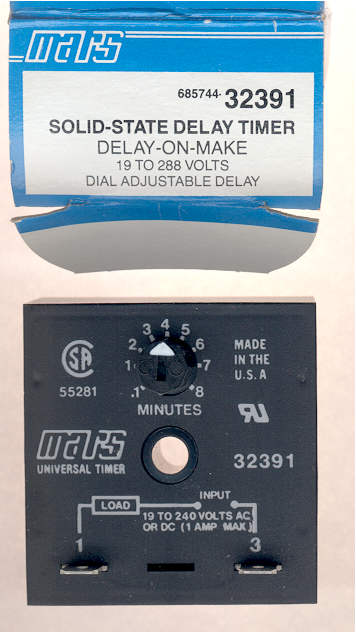
As an example.  No, this isn't the correct timer for this application
- just a photo of an example unit.  These timers are very cheap -
under $20, very reliable and easy to use.  Arrange the circuit so that
when the fridge thermostat calls for cooling, the aux load is
energized for say, 15 seconds, then the timer de-energizes the aux
load and energizes the compressor.  The TDR and one or two relays is
required.  A gas furnace fan delay module (slightly more expensive)
will do the job with no additional hardware.

An alternative that is even simpler involves using an HVAC thermal
delay contactor.  This type of contactor involves a Klixon-type
thermostat with a heating element bonded to it.  When energized, the
heater causes the Klixon to change states after a delay for heating. A
similar delay occurs upon de-energizing as the element cools.  These
things are also dirt-cheap and found in furnace blower controls, heat
pump blast coil controls and so on.

Arrange things so the fridge thermostat applies power to the heater
and to the contacts.  The NC contact goes to the aux load and the NO
contact to the compressor.  After the heating delay passes the aux
load is de-energized and the compressor energized.  No aux relays
needed.

That said, I see no need for anything more complicated than plugging
in a small load and allowing it to operate all the time.  A 100 watt
lamp is more than enough to spin up my (non-EU) inverter generator
enough to start high-inrush loads. The fuel penalty is minimal and not
worth my effort to negate.

John
From: John De Armond
Newsgroups: alt.home.repair,alt.energy.homepower
Subject: Re: Honda generators
Date: Fri, 19 Sep 2008 23:01:15 -0400
Message-ID: <akp8d492aduqrkb3cvqhhmmjpm9lpte94e@4ax.com>

On Fri, 19 Sep 2008 12:52:46 -0500, zxcvbob <zxcvbob@charter.net> wrote:


>The refrigerator doesn't run all the time, it cycles on/off.  And I
>/might/ not have to run the A/C.  Even running a few hundred fewer RPM's
>for half the runtime has got to be easier on the engine.  I expect it
>will be running less than 1000W most of the time, but I wonder if it has
>enough surge capacity (The Yamaha 2400 is an honest 2000W inverter and
>it's rated 6000W for 3 seconds.  I like that.  It also weighs a lot
>more; not sure if it can be shipped UPS Ground.)

Thing is, the inverter generator engines actually turn FASTER with significant
load than a constant speed generator.  For example, per the manual, the EU2000
turns 5000 RPM at full load.  They don't give any indication in the manual as
to what the load vs speed slope is but from first hand experience, it doesn't
take much load to get the engine spinning rapidly.

>I need to wait another couple of weeks for Texas to be powered-up again,
>then start calling the generator dealers.  Especially the ones in
>Wisconsin because it's not so far/expensive to ship from there.

Check around the net.  Many of the larger generator dealers offer free
shipping.

John
From: John De Armond
Newsgroups: alt.home.repair,alt.energy.homepower
Subject: Re: Honda generators
Date: Fri, 19 Sep 2008 22:52:32 -0400
Message-ID: <3rl8d49ojedpe2619qc07h4ksq9ca4r208@4ax.com>

On Fri, 19 Sep 2008 12:09:03 -0500, zxcvbob <zxcvbob@charter.net> wrote:

>
>In alt.energy.homepower Neon John <no@never.com> wrote:
>
>> Yes, that's a honda thing.  If your needs fit an inverter generator
>> (most people's don't), I recommend the Yamaha line, partially because
>> of the honda thing.  The Yamahas are actually better units and Yamaha
>> doesn't have that same price-fixing attitude of honda.
>
>
>I want to be able to run my furnace blower, gas oven ignitors,
>refrigerator, TV, laptop computer, and a few fluorescent lights during
>an extended power outage during the winter. Or during the summer, the
>same thing except a 8000 BTU (11 EER) window A/C instead of the furnace.
>  I also have a couple of freezers that might need to be plugged in a
>couple of hours each day, but I could unplug the fridge when I do that.
>  I think I could get by OK with a generator rated for 110V 1600W
>continuous power.  I could certainly get by with it a lot better than I
>could with no generator at all.
>
>The Honda is also a nice size to throw in the back of a truck to take to
>a job site to run 110V power tools, like various electric saws or lighting.

Your parents' experience with the gas hog is one reason why I asked the
question.  Far too many people find out the hard way about how much fuel it
takes to keep a 4 or 5kW generator running.

Unless you go for the very high dollar 3 or 4kW versions, an inverter
generator isn't a good match for your load mix.  The reason is that they have
no surge reserve.  That is, no motor starting reserve.

For instance, the EU2000 has a continuous rating of 1,600 VA (nice little fib
there in the model number) but a peak of only 2000 VA.  A momentary load, say,
starting the compressor of the AC, of even a tiny bit over 2000 VA and the
inverter shuts down, requiring an engine stop and restart.

A conventional generator, OTOH, may slow down a little and dip the voltage but
it will supply much more surge current than its nominal full load rating.  In
isolation, an EU2000 or Yamaha equivalent would probably run any of the items
you mentioned (minor question on the AC)  The problem is trying to run several
loads at once.

For instance, you might have the lights, a PC and the refrigerator running
when the little AC tries to start.  There simply isn't enough headroom left to
do the job.

Yamaha has addressed this problem with their "boost" technology that uses the
cranking battery to supply surge current

http://www.yamaha-motor.com/outdoor/products/modelhome/444/home.aspx

But this is a high dollar generator.

What I recommend is to get two different generators: a little 1kW unit to run
your lights, PC and other light loads and a larger one, say 2500 watts, for
the AC, furnace blower and perhaps the refrigerator. (depending on the fridge,
it might run on the 1kW unit.)

The 1 kW unit which just sips fuel, can be run all the time.  The larger
generator can either be started and stopped as needed or can use the no-load
idle-down feature that almost all constant-speed generators have to return to
idle when no load is applied.

Buying chicom generators, you can get two for less than the price of one big
name inverter generator.  The 1kW 2-stroke unit that Northern Tool and others
sell for as little as $99 does a fine job.  I have two of 'em.  One of those
will start and run my electric lawn mower, something my 2,500 watt inverter
will not do.  A 4-stroke version is about double that price but, IMO, not
worth it.  The 2-stroke version is fairly quiet and with "no smoke" oil like
Northern Tool sells, emits almost no fumes.

Harbor Freight, Pep Boys and many other similar places sell a nice little 2500
watt generator in the $300 range.  Some versions use a honda clone engine
manufactured under license from Honda.  (I know the Pep Boys one does, not
sure about the rest) Here's Harbor Freight's version:

http://www.harborfreight.com/cpi/ctaf/displayitem.taf?Itemnumber=92456

If you dedicate the 2500 watt unit to the AC, furnace fan and perhaps the
refrigerator then it can idle down when there is no load, further conserving
fuel.

If you really just want 1 generator then I'd go with something in the 2500
watt class.

John
Index
Home
About
Blog