Index
Home
About
Blog
From: John De Armond
Newsgroups: rec.outdoors.rv-travel
Subject: Re: Generator output - was Meanwhile-Back to RV's
Date: Fri, 01 Dec 2000 02:37:45 -0500

Stanley Miller wrote:

> On Thu, 30 Nov 2000 12:58:32 GMT, W F Sill <will@epix.net> wrote:
>
> >Not long ago, Stanley Miller <skp51443@tds.net> wrote:
>
> >>I think that if you put many rv generators on a scope you will see a
> >>distorted waveform with lower peak voltages than power company power.
> >>Better quality generators have less of a problem with this than do the
> >>cheapies and smaller units. Lightly loaded units display less sag than
> >>heavily loaded units.
> >
> >Stan, you said "I think".  OK, that's fine, but IMO you are dead
> >wrong.  I got rid of my scope many years ago but have never seen a
> >difference in output beween a properly running genset and grid power.
> >Unless you are using some kind of square wave generator (not the norm)
> >you cannot get 120vac RMS without getting 170v peak values at 60 Hz.
> >We have a 7kw standby genset  & 200a transfer switch here in out home
> >and can run anything in the house with no detectable difference except
> >for the noise of the gen.
>
> Please note I said better quality generators and that lightly loaded
> ones have less problems. Yours sounds both high quality and not loaded
> to it's limit. Grab a cheap one that is being taxed near it's maximum
> power and you might notice the problem I was referring to.
>
> I did not say that the output voltage didn't show as lower on an RMS
> meter. It does show as lower on my cheapie but it isn't RMS...
>
> I never had a problem with my 30 KW unit but when I retired Uncle Sam
> wanted to keep it and I had to downsize.

[snippity]

> Took a quick look online to see if I could find someone sharing my
> opinion with little luck. I did a quick catalog search in my shopping
> pile and did find find several RE dealers selling 10% voltage boost
> transformers for correcting sagging voltage from generators to restore
> full performance to your charger. If you have a Backwoods Solar
> catalog it is discussed in it.
>
> Since I can't find indisputable evidence to prove my point I will
> leave the field of battle.

No need to do that, Stan.  Certainly no use in letting Bozo beat you
down with his usual ignorant posturing. Ur hmbl svt is ever ready to
hang a scope on something interesting and toss the results up on the
net. Look here:
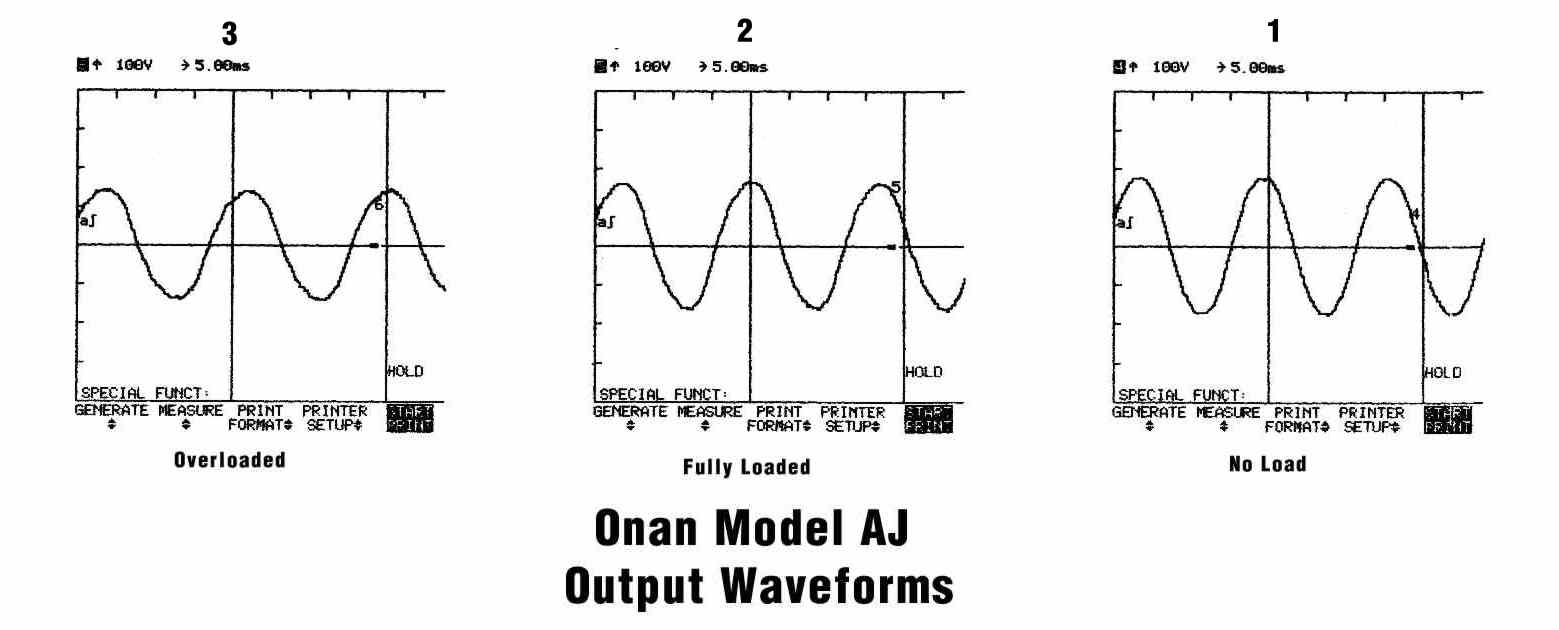
What we have here is a series of scope shots of the output of my
Onan AJ genny under different conditions.  A couple of notes before
I explain.  The AJ is a self-regulating or as some refer to it, a
saturated field generator.  That is, the generator is designed to be
inherently voltage regulating.  The field is driven at a fixed level
sufficient to saturate the magnetic circuit.  There is no external
voltage regulator.  These generators generally (but not always) have
better waveforms than actively regulated generators.  I know from
examining other generators that this is a better-than-average case.
I would have done this procedure on my Yamaha but it's in winter
lay-up mode.

Photo 1 (onan_1.jpg) is the generator running unloaded.  Photo 2 is
the generator running fully loaded.  The generator has slowed a bit
and the frequency has dropped.  And one can see the beginning of
some distortion on the waveform right before the center graticule.
Photo 3 is the generator overloaded (with this generator, the engine
overloads far before the alternator.)  Both the voltage and
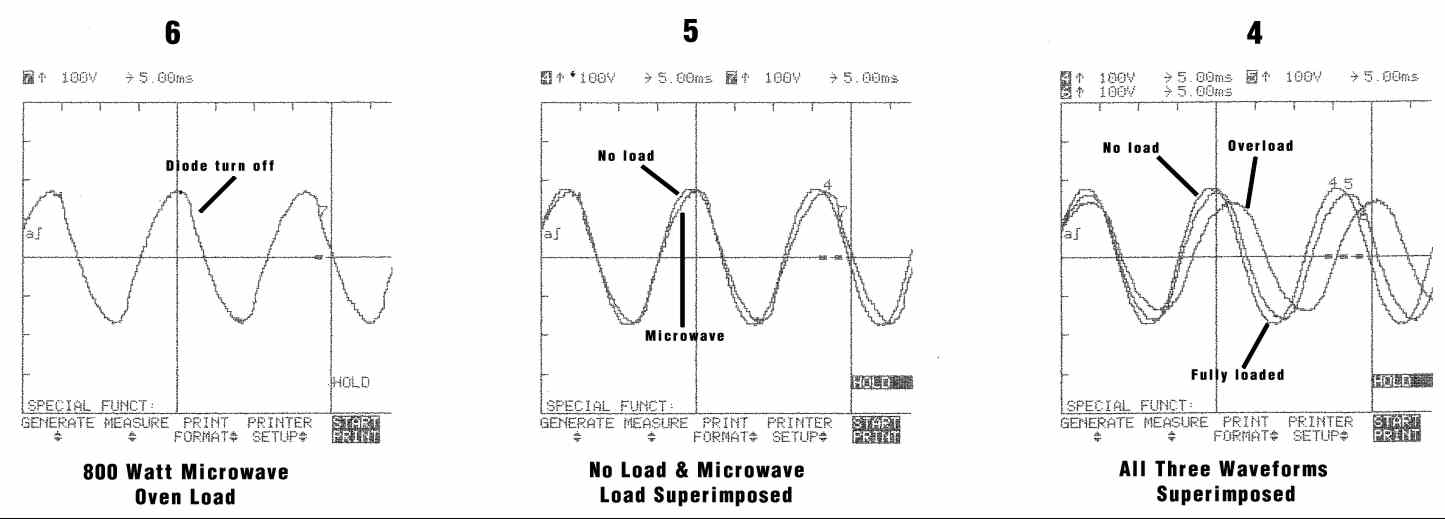
frequency have dropped and the distortion is noticeable.  Photo 4
(onan_2.jpg) shows the 3 waveforms overlaid.  This shows the
differences in the waveforms very graphically.

Where small generators get really hinky is when they drive
non-linear loads.  A typical non-linear load will have a rectifier
(bridge) downstream of a transformer with the rectifier feeding an
energy storage device (capacitor, battery, etc.)  A couple of
examples are the microwave oven and the battery charger.  Photo 6
shows the generator waveform when running a small microwave oven.
Though this oven is only a small load on the generator, it causes
significant distortion.  The distortion occurs when the diode
rectifier in the microwave suddenly conducts when it becomes forward
biased.  This is almost identical to the waveform one would see when
driving a battery charger.  In general, generators with active
regulators and lesser amounts of iron and copper exhibit poorer
waveforms.  Again, my AJ is better than most that I've observed.
Photo 5 shows the no-load waveform with the microwave oven waveform
overlaid.

Stan, I imagine what's happening with your battery charger and
generator is that the charger is causing distortion similar to Photo
5 and possibly affecting the active regulator if your genny has
one.  On my genny without a regulator, my battery charger behaves
essentially the same as on shore power.

I have a simple way of addressing poor waveform, low voltage and any
desire I might have for a higher charging voltage/current.  That is
to hook my battery charger through a variac.  The variac lets me run
the voltage up as high as I need to get the charging current I
want.  When I have to REALLY cram a charge in the batteries on my
rig, I roll out my 15 volt, 250 amp DC power supply and power it
through a variac.  I can run the current all the way up to the
limits of the power supply if I want to.  You might consider getting
a small variac.  There are always some for sale on Ebay as well as
the various electronic surplus houses.  Very handy gadget to have
around.  If you get a high powered charger like mine, it is
important to disconnect the batteries from the rig so that the high
voltage necessary to force that kind of current won't affect
anything in the rig.

John
Index
Home
About
Blog