Index
Home
About
Blog
From: John De Armond
Newsgroups: rec.outdoors.rv-travel
Subject: Re: Generator Noise -- Super Trapp Mufflers
Date: Thu, 01 Jan 2004 02:19:16 -0500
Message-ID: <e4f7vvgua62i8plb52afcqtck6mj7rf41b@4ax.com>

I use Super Trapp mufflers on race vehicles.  You can have quiet or you can
have performance (by varying the disc count) but you can't have both at once.
Even with just a few discs, the Super Trapp is still quite noisy for your
application.

This guy here makes a super-quiet RV muffler.

http://www.advrv.com/prices.htm

Scroll about 2/3 down the page to "generator options" and then look for "Sound
Package Muffler (super quiet)" in red print.  $175.

I bought one of these mufflers.  It is amazing.  I have it deployed on an 8kw
Generac portable generator that I use with my concession stand.  I can't find
a photo of the generator with the muffler mounted but I do have one of the
muffler as it arrived:
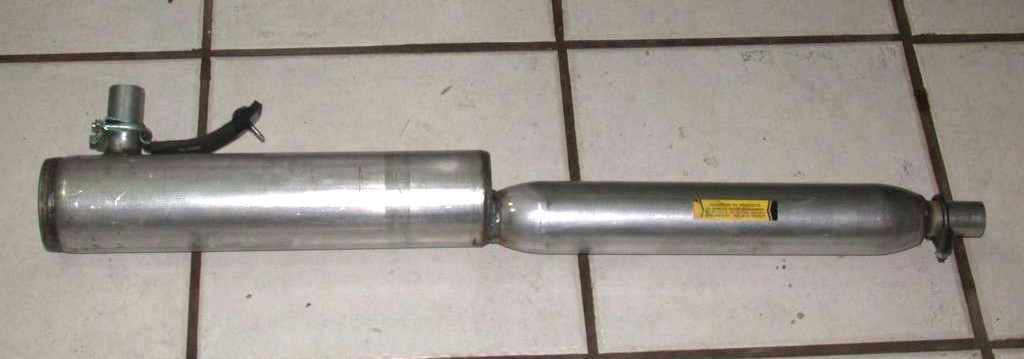
This thing is made from aluminized steel and weighs probably 35 lbs.  For the
last month the Generator and stand have operated every day, with the generator
out in the weather.  There is zero rust.  Not even on the welds which really
surprised me.  The inlet of the muffler runs a dull red, easily visible at
night, so the lack of corrosion is doubly amazing.

There is essentially no noise emitting from the exhaust other than the fairly
steady whoosh of gas.  The exhaust note has been reduced such that one can
hear it if listening carefully but not otherwise.

Now.  Since I've already done what you're thinking about doing, some comments.
A lot of noise comes from the exhaust but not nearly all of it.  My Generac with
the super-quiet muffler is still noisy, far too noisy to use in a CG.

Much of the noise comes from the intake roar.  This is much more problematic
to silence, since there has to be an air cleaner in the path and since the
intake right up to the carb on the Generac is plastic.  I've experimented with
a commercial air compressor muffler/air cleaner with some results.  This
Speedaire unit, available from Graingers, uses tuned tubes to cancel the
steady drone of the air compressor.  The frequency of the generator is much
higher, as it runs much faster, so some trimming of the tuning tubes is
necessary.  I haven't installed it on this generator because it is too small.
Probably OK for a 4 or 5 kw generator.

Other major sources of noise include the valve train, the cylinder fins and
the crankcase walls.  I've applied liquid rubber such as used in bed liners to
the crankcase which helped some.  Keeping the valve train adjusted tight
reduces the noise at the risk of a burnt valve.  No solution yet for the
cylinder and head fins, which can't be coated.

What I finally did was to make a plywood box that would go around the
generator.  It is 5 pieces, 4 walls and a top, that clip together using
hardware store removable hinges to make a rather soundproof box.  The pieces
are lined on the inside with acoustic foam.  There are air holes in the proper
places, baffled to prevent line-of-sight sound transmission.

This does a remarkable job of attenuating the noise.  Most of what escapes is
cooling fan and intake noise.  This setup, at the end of a 150 ft long hunk of
6/4 SO cable, is perfectly satisfactory for an event where there is already a
lot of noise.  But I still wouldn't use it in a camp ground.

Your best bet is to see if you can get your money out of that generator and
then buy one suitable for camping.  Low noise emission is something that has
to be designed in and not added on.

BTW, if charging your batteries is all you need a genny for, you might
consider building something similar to my Cordless Battery Charger:

http://bellsouthpwp.net/j/o/johngd/files/rv/cordless_battery_charger/

(man, I really do need to update those photos of the prototype!)

This unit generates 150 amps at 12 volts nominal.  This prototype uses a
commercial 3 stage smart regulator.  The Honda dispos-a-motor :-) is very
quiet mechanically, only requiring some additional muffling to make it CG
friendly.  The whole thing weighs about 50 lbs and so is man-portable.  It
will bring my pair of Group 29 batteries (about 230 ah) up to 80+% charged in
about an hour.

The costs are approximately as follows:

Engine				$180	Northern tool
150 amp caddy alternator	$40	Local auto-electric shop*
InCharge regulator		$120	West Marine
Cog belt Pulleys & belt		$50	Local machine supply
Machining the cog pulley to
  fit the alternator shaft	$30	Local small machine shop
Misc stuff (cable, clips, etc)	$50	Auto parts store, etc.

* I got a used alternator from my local auto-electric shop.  I had him rip out
all the internal regulator parts, then rebuild it with new bearings and
brushes. The shaft is metric so I had a local machine shop bore a cog belt
pulley to fit the shaft.

I have the alternator geared to fully load the engine at 150 amps out.  Once
the battery takes on some charge, the current starts dropping and the engine
can be throttled back significantly, greatly reducing the noise.  Once most of
the bulk charge stage is complete (30-45 mins, depending on the starting state
of charge), the throttle can be reduced to just above idle.  I'm almost
finished with a computerized controller that does the throttle control
automatically.

I do a lot of dry camping.  On a typical cold winter day, with the furnace,
lots of light, the 12v electric blanket running and several rounds of heating
food in the inverter-driven microwave, I can suck 100-125 ah or more from the
house batteries.  The CBC can put that charge back in 45 mins to an hour.  I
usually run it in the early afternoon, a time that I think is least
bothersome.  If I walk around to the back of my rig while this thing is
running I can only barely hear it so I know it can't bother anyone else very
much.

John


On 31 Dec 2003 11:24:34 -0800, trmitchell@hotmail.com (Tom Mitchell) wrote:

>Has anyone tried the Super Trapp mufflers sold by Jack's Small
>Engines, to make a dent in the 5000kw Generac's excessive noise?
>
>http://www.jackssmallengines.com/quietmuf_index.html
>
>We bought the cheapy $500 Generac to make remote fence mending easier,
>and with only got about ten hours on it, frugality makes it hard for
>to replace it. But we don't want to be the noise polluter of yet TBD
>serene boondock sites, when we light the yammmering thing up to
>recharge the batteries every day.
>
>It's pull-start, so the plan is to have it rubber-mounted in the bed
>of the dually, with a cover for rain. If the Super Trapp can make a
>reasonable reduction in the DBA's, we want to make the retrofit.
From: John De Armond
Newsgroups: rec.outdoors.rv-travel
Subject: Re: Generator Noise -- Super Trapp Mufflers
Date: Thu, 01 Jan 2004 18:59:06 -0500
Message-ID: <orb9vv8i1mdshkv2jeo80q8b66p7nt0o9j@4ax.com>

On Thu, 01 Jan 2004 21:43:59 GMT, Peter T. Arnold <PM7088@comcast.net> wrote:


>>* I got a used alternator from my local auto-electric shop.  I had him rip out
>>all the internal regulator parts, then rebuild it with new bearings and
>>brushes. The shaft is metric so I had a local machine shop bore a cog belt
>>pulley to fit the shaft.

>I guess I have to ask a stupid question here, my first of the New
>Year.
>Why not use the internal regulator that comes with the alternator?

Not a dumb question at all.

The stock alternator outputs a constant voltage.  It varies a little with
temperature but not much.

The reason for 3 stage charging is speed.  The conventional alternator will
put about half the charge back in a few hours.  It will take a day or more to
finish the job, according to my E-meter's data logging.  The three stage
regulator behind a 150 amp alternator can bring the battery to 80+% charge in
an hour or less.  It can bring it all the way to the top in 3-4 hours.

To perform a three stage charge cycle, the regulator must output three
different voltages.  During the first or bulk stage, the regulator drives the
alternator to output its max current while the voltage trip point is set to
around 14.8 or so, depending on temperature.  The battery voltage will
gradually rise until it hits the trip voltage.  The battery will be about 80%
charged at that stage.

The regulator enters the second stage or absorption.  Here the voltage is held
constant, usually at the same voltage as before, while the current gradually
drops as the battery accepts charge.  The absorption stage ends either via
timer (cheap regulators) or a second trip point.  The trip point is usually 1
or 2% of the initial absorption current.  If the initial current was 100 amps,
then the trip would be 1 or 2 amps.  The final stage is the float stage where
the output is regulated to a set value, around 14 volts at 70 degrees.  This
stage continues as long as the generator runs.

That InCharge regulator is a cheap one and controls the absorption stage by
time.  Around 3 hours for my battery bank.  It is adequate on a one-shot
charger like this one.  I would not use it as the main vehicle regulator.
Ample Power makes one of the best.  You can read about it on their web site:
http://www.amplepower.com.


John
From: John De Armond
Newsgroups: rec.outdoors.rv-travel
Subject: Re: Generator Muffler
Date: Tue, 22 Feb 2005 00:49:07 -0500
Message-ID: <n0hl11dctk7gpelp3tq9uh0713v53etgjc@4ax.com>

On Mon, 21 Feb 2005 17:44:02 -0500, "Steve Wolf" <news@w8iz.com> wrote:

>I have a cheap 5 kw generator on a cart that is unbelievably loud.  I've
>reviewed the past threads about adding a better muffler to a generator.  I
>understand that mechanical noise is a good portion of the noise.  I am not
>interested in a "stack".  I am not interested in an Onan/Genrac replacement.
>I'm not convinced I want to shell out $200 for the super quiet job we have
>discussed before
>(
).
>The cost would be about half what I paid for the generator.  Has anyone
>welded up an adapter for a cheap car muffler?  I understand that might not
>do what the super quiet job will do.  I bet it would be better than what I
>have.  I have no experiences to draw on for this project.  Can anyone WHO
>HAS ACTUALLY PLAYED WITH THIS shed some light on what I should expect?  I am
>looking for someone who has actually removed an existing muffler and toyed
>with replacements.

I have.  I have tried:

Compact car muffler
full size car muffler
a variety of tractor mufflers from Tractor Supply
Muffler shop Onan replacement which turned out to be a glass pack.

None did much of anything and after I thought about it for awhile I
realized why.  All are designed for multi-cylinder engines with damping
structures designed for higher frequency impulses and higher gas volumes
than a small engine generates.  The glass pack one actually worked a
little.

An additional problem with oval shaped car mufflers is that the flat sides
act as sounding boards, radiating the impulses.  I tried a compact car
(thinking the 4 cylinder high RPM engine might have a muffler design
closer to what I needed) on my Generac generator in my MH.  This genny
already has a small muffler built in.  While the sound coming from the
exhaust tip was lower, the sound in the house right above the muffler, and
to the side of the MH was about 6 db LOUDER.

I performed some experiments including welding pieces of pipes containing
steel and lead shot to the flat surfaces in an attempt to dampen the
noise.  Both somewhat worked but I decided that it was getting far over
the kludge edge and decided to look elsewhere.

That super-quiet muffler consists of a simple baffled expansion chamber
followed by a glasspack muffler.  I have not yet looked at the expansion
chamber but the guy at Advanced RV said that it was quite simple.  I've
been meaning to X-ray the thing but haven't gotten around tuit yet.

Bottom line:  I haven't found one off-the-shelf yet that is inexpensive
and does much of anything.  The Onan muffler is quite quiet but offers
significant restriction.

If I were building one from scratch today I'd probably look at a Hemholtz
resonator design.  Google for that and if you need more info I'll explain.
Since the genny runs at a constant RPM, a narrow band Hemholtz should do
the job nicely.  A reentrant design would be easy to fabricate and design.
I'd probably make a telescoping one to find the right dimensions with and
then weld up a solid one.

My Caprice 9C1 car uses two Hemholtz resonators with great effectiveness.
Look here:

http://www.9c1.com/gallery/articles/motortrend_03_03.jpg


The resonators are the two ribbed structures in the small engine
compartment photo.  The big home-plate shaped one tees off the intake
track and the other one is a flow-through.  The big one handles low speed
rumble and the other high speed roar.  A lot of people take them off.  I
tried it but did NOT like the constant drone in the cockpit.

You might want to think about a resonator on the intake also.

John
From: John De Armond
Newsgroups: rec.outdoors.rv-travel
Subject: Re: Generator Muffler
Date: Tue, 22 Feb 2005 01:05:24 -0500
Message-ID: <sail11h5jhh4rhci615sbd56eibm1higqn@4ax.com>

On Mon, 21 Feb 2005 18:06:34 -0800, altar1@omnicast.net wrote:

>On Mon, 21 Feb 2005 17:44:02 -0500, "Steve Wolf" <news@w8iz.com>
>wrote:
>
>>I have a cheap 5 kw generator on a cart that is unbelievably loud.  I've
>>reviewed the past threads about adding a better muffler to a generator.  I
>>understand that mechanical noise is a good portion of the noise.  I am not
>>interested in a "stack".  I am not interested in an Onan/Genrac replacement.
>>I'm not convinced I want to shell out $200 for the super quiet job we have
>>discussed before
>>(
).
>>The cost would be about half what I paid for the generator.  Has anyone
>>welded up an adapter for a cheap car muffler?  I understand that might not
>>do what the super quiet job will do.  I bet it would be better than what I
>>have.  I have no experiences to draw on for this project.  Can anyone WHO
>>HAS ACTUALLY PLAYED WITH THIS shed some light on what I should expect?  I am
>>looking for someone who has actually removed an existing muffler and toyed
>>with replacements.
>>
>>Thanks!
>>Steve
>>www.wolfswords.com under the motorhome tab
>>
>Jacks small engine on the web sells a supertrapp muffler for noisy
>generators. I spent the $70 for my coleman powermate last year, and it
>made tons of difference. It is not, nor will it ever be as quiet as a
>Honda, but when it's running nobody wants to kill you.

I have a lot of experience with the SuperTrapp muffler because we used to
use them on our race cars.  They are very expensive for what you get.
There is a direct tradeoff between noise and restriction.  My generac
portable generator, at least, won't withstand much restriction and still
make full power.  Not to say it isn't worth a try.

Steve, if you want to give that a shot without spending a lot of money,
what follows is a description of the super-trapp.  You can build one of
your own using a small glass pack muffler (cherry bomb) as the start.

It is nothing more than a glass pack muffler with the far end cut off and
a series of baffles fitted.  On the baffle end there is a rectangular
plate welded across the opening and from this extends a threaded rod.  The
baffles are stacked on this rod.  An end-cap is fitted along with a nut.
The baffles are dimpled so that there is perhaps 1/16" between them when
stacked.  The exhaust exits through the spaces between the baffles.

More baffles in the stack = more noise but less restriction.  Less baffles
= less noise but more restriction.  The baffle stack can be a tuning aid -
some engines respond to a little bit of restriction with more power than
with an open muffler.

The cheapest way I can think of to construct your own would be to cut the
end off a glass pack, weld in the plate and stud and then mount baffles
that you ordered from SuperTrapp.  They sell "tuning packs" of baffles.  I
just looked them up here:

http://www.supertrapp.com/product_sections/universal/index.asp

And see that a 6-pack of 3" baffles is $13.

I also noticed that they are right in your back yard in Cleveland, OH.
Maybe you could go over and mooch a sample.  Or at least get some advice
regarding this application.

BTW, you might also try this design as an intake muffler.

John
Index
Home
About
Blog